Art Auctions - English Language Aste Arte - Lingua Italiana Subastas Arte - Langue Espagnole Ventes aux Encheres Art - Langue Française Kunstauctionen - Deutsch Leilões de Arte - Português Аукционы искусства - Руссо الفن المزادات - العربية
Register - Resend Password
Arcadja Auctions

Jan Van Der Heyden

Follow the artist with our email alert
Netherlands (16371712 ) - Artworks Wikipedia® - Jan Van Der Heyden
HEYDEN van der Jan A Wooded Landscape With A Figure In A Park

Christie's /Apr 25, 2008
31,804.60 - 44,526.44
53,258.14
Find artworks, auction results, sale prices and pictures of Jan Van Der Heyden at auctions worldwide.
Go to the complete price list of works
Along with Jan Van Der Heyden, our clients also searched for the following authors:
Jan Claesz. Rietschoof, Cornelis De Wael, Jacobus Storck, Felice Boselli, Gillis Rombouts, Giuseppe Antonio Petrini, Hendrick Mommers


Artworks in Arcadja
40

Some works of Jan Van Der Heyden

Extracted between 40 works in the catalog of Arcadja
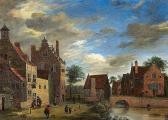
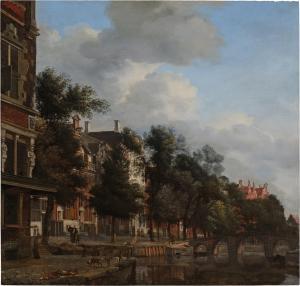
Jan Van Der Heyden - An Einer Gracht In Amsterdam

Jan Van Der Heyden - An Einer Gracht In Amsterdam

Original
Estimate:

Price:

Gross Price
Lot number: 1319
Other WORKS AT AUCTION
Description:
JAN VAN DER HEYDEN (1637 Gorinchem - 1712 Amsterdam) AN EINER GRACHT IN AMSTERDAM Öl auf Holz. 39 x 40 cm. Provenienz Sammlung Backofen, Basel 1919. - Sammlung E. Paravicini-Backofen, Basel 1932. - Sammlung Vischer-Backofen, Basel 1934. - Sammlung Lady Gleconner. - Sotheby´s London 14.12.1977. - Deutsche Privatsammlung. Ausstellungen Kunstverein Basel: Kunstwerke aus Baseler Sammlungen, 1928, Nr. 130. Literatur Helga Wagner: Jan van der Heyden, Amsterdam und Haarlem 1971, Nr. 89, Abb. S. 146. Schon zu Lebzeiten galt Jan van der Heyden als der bedeutendste Maler der holländischen Stadtansicht und dies vor allem wegen seiner Bilder von Amsterdam. Neben ihm wäre nur noch Gerrit Adriansz Berckheyde zu nennen. Bewundert wurde insbesondere die Feinheit seiner Backsteinmauern und Architekturdetails, die nach seinem Tode noch Arnold Houbraken in Begeisterung versetzte. Doch die präzise Zeichnung allein macht nicht die Schönheit von van der Heydens Grachtenbildern aus, sondern vor allem auch ihre ruhige Beschaulichkeit und Poesie, die geheimnisvolle Harmonie von Vorder- und Hintergrund, von Licht und Schatten. So sehr in seinen Bildern auch das Auge angezogen wird von den reizvollen Details, die so liebevoll und virtuos bis in die Ferne ausgebreitet werden, so stören sie nie den Zusammenhang des Gesamteindrucks. Sie drängen sich nicht vor, sie regen nur an, weiter in die Tiefe des Bildes einzusteigen und alle Einzelheiten, das feine Kolorit und den perspektivischen Bildaufbau zu bewundern. Zunächst scheint der Ausschnitt von van der Heydens Bildern rein zufällig zu sein, aber die Abweichungen bei den einzelnen erkennbaren Grachten zeigen doch, wie sorgsam der Künstler diese Zufälligkeit plante, wie er seine Bilder komponierte. Der Blick wird meist schräg in die Tiefe geführt, oft zunächst unterbrochen durch einer im ruhigen Gewässer sich spiegelnde Brücke. Eine besondere Rolle kommt in seinen Bilder dem Licht zu. Van der Heyden hat meistens bei sehr tief stehender Sonne gemalt, wodurch interessante Beleuchtungseffekte, Streiflichter und Kontraste entstehen. Der Himmel ist oft wolkig und so fällt das Licht ungleichmäßig auf die Szene. Brückenbogen und Bäume fangen dieses Lichtspiel auf. Seine besten Bilder sind nie bunt. Bei aller Liebe zu Lokalfarben sind diese doch so aufeinander abgestimmt, dass sie eine gedämpfte Harmonie bilden. Spiegelungen der Häuser und Brücken im dunklen Wasser beleben den Mittelgrund. Die Atmosphäre der Stadt wird auf so lebendige Weise eingefangen, dass die Amsterdamer Ansichten zu seinen absoluten Meisterwerken zählen. Zur abwechslungsreichen und lebendigen Wirkung tragen auch die Staffagefiguren bei. Sehr häufig und auch in diesem Bild stammen sie von Adrian van de Velde. Der Brückentyp entspricht dem in der Heren- und Keizergracht in Amsterdam, also den im Westen der Stadt vorkommenden Brücken (H. Wagner op. cit.). During his lifetime Jan van der Heyden was already considered to be the most important painter of Dutch town views and renowned for his pictures of Amsterdam. The only other painter comparable to him would be Gerrit Adriasz Berckheyde. Most admired was the fine detail of his stone walls and architectural details that even after his death delighted Arnold Houbraken. But the precise drawing alone does not constitute the beauty of van der Heyden's paintings of the canals but their sereneness and poetry, the mysterious harmony between foreground and background, light and shadow. As muck as the eye is attracted to the charming details that are displayed so lovingly and with virtuosity into the distance, they never disturb the continuity of the entity. They do not become forward, instead they inspire deeper submersion into the painting to admire all details, the fine colour application and perspective. At first the plan of van der Heyden's paintings appears almost accidental, but the differences in every single canal show how carefully the artist planned the coincidence in his paintings' composition. Mostly, the view is led diagonally into the deep, often interrupted by a bridge's reflection in calm water. A particular role is played by light. Van der Heyden mostly painted during very low sunlight that produced interesting effects, fleeting lights and contrasts. The sky is often cloudy and the light is falling irregularly onto the scene. The bridges' arches and trees capture this plag of light. His best paintings are never colourful. For all love of local colours, they are so compatible to form a still harmony. Reflection of houses and bridges in dark water enliven the centre. The city's atmosphere is captured in such lively way that the Amsterdam paintings are his absolute masterpieces. The figures of the staffage also add to the varied and lively Impression. Very often and also in this painting they are by Adrian van de Velde. The type of bridge is that of the Heren and Keizer canals in Amsterdam, in the western part of town (H. Wagner opp. cit.).
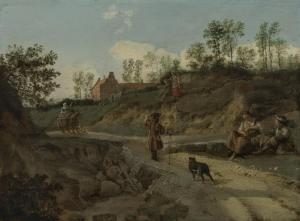
Jan Van Der Heyden - View Of Goudestein With A Woman And Child Walking Beside Adyke

Jan Van Der Heyden - View Of Goudestein With A Woman And Child Walking Beside Adyke

Original
Estimate:

Price:

Gross Price
Lot number: 2
Other WORKS AT AUCTION
Description:
LOT 2 JAN VAN DER HEYDEN GORINCHEM 1637 - 1712 AMSTERDAM VIEW OF GOUDESTEIN WITH A WOMAN AND CHILD WALKING BESIDE ADYKE signed with monogram: JVH oil on panel 80,000—120,000 USD measurements measurements note 9 by 11 1/4 in.; 23 by 28.5 cm. Description signed with monogram: JVH oil on panel PROVENANCE By descent to the artist's son, Jan van der Heyden;G.J. Maxwell Lefroy, Itchen Manor, Hants, England;Arthur M. Grenfell, Esq., London;By whom sold, London, Christie's, 26 June 1914, lot 16, therepurchased by Coureau;With Julius Böhler, Munich, 1915;Anonymous sale ("Property of a Midwest Private Collector"), NewYork, Sotheby's, 12 January 1989, lot 118, unsold;Anonymous sale, New York, Christie's, 29 January 1998, lot109;There purchased by the present collector. LITERATURE AND REFERENCES Oud Holland, XXX, 1912, p. 134;C. Hofstede de Groot, A Catalogue raisonné of the Works of the MostEminent Dutch Painters of the Seventeenth Century, London 1927,VIII, p. 350, cat. no. 72;H. Wagner, Jan van der Heyden 1637-1712, 1971, pp. 95-96, cat. no128, reproduced p. 95, no. 128 (as by Jan van der Heyden, withfigures executed by Adriaen van de Velde);G. Schwarz, "Jan van der Heyden and the Huydecopers ofMaarssenveen," in The J. Paul Getty Museum Journal, vol. II, 1983,p. 217, note 62;P. C. Sutton, Jan van der Heyden (1637-1712), exhibition catalogue,Greenwich, Ct. 2006, p. 62, note 85. CATALOGUE NOTE The country estate, Goudestein, was located on the river Vechtnear Maarssen and Maarsseveen. The Vecht had become a popular sitewith Amsterdam's wealthy citizens upon which to build their countryhouses. Goudestein, which was built for the powerful Huydecoperfamily, was one of the grandest. At the time this view was painted,it belonged to Joan Huydecoper II who inherited the position ofLord of Maarsseveen and Neerdijk following his father's death in1661. He was a member of the Amsterdam Town Council, became adirector of the East India Company in 1666 and burgomaster in 1673.During this time, he was an important patron and supporter of bothJan van der Heyden and his brother, Nicolaas. Through Joan II'sauspices, Jan was appointed supervisor of street lighting inAmsterdam and later, with his brother, head of firefighting. Thesecareers, in fact, proved far more lucrative for Jan than hisartistic one. Van der Heyden painted at least six views of Goudestein fromdifferent aspects of which two are dated in the years 1666 and1674.1 Two views were listed in the 1712 inventorylisting of the artist's widow and the present work is thought to beidentifiable with one of these two.2 The Goudesteinhouse depicted by van der Heyden was eventually torn down andrebuilt in 1754. The house remained in the Huydecoper family until1955 when it was sold to the town of Maarssen and now serves as theTown Hall. 1. See Wagner, op.cit., cat. nos. 129 and 125 (WellingtonMuseum, Apsley House).2. Hofstede de Groot, op.cit., identifies the present painting aspossibly no. 34 of the inventory while Wagner, op.cit., identifiesit as possibly no. 35, both of which were designated for thepainter's son, Jan: "De plaats van Goudestein, van voore klyn [Theplace of Goudestein, in front small], no. 34, in the share of JanJr.; and "Ditto van Achteren klein, met leist" [The same from theback small, with frame].
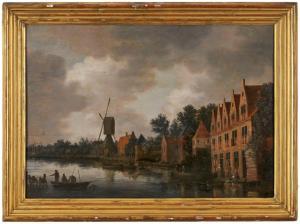
Jan Van Der Heyden - Delft, A View Of The Oude Delft And The Gemeenlandshuis

Jan Van Der Heyden - Delft, A View Of The Oude Delft And The Gemeenlandshuis

Original
Estimate:

Price:

Net Price
Lot number: 22
Other WORKS AT AUCTION
Description:
LOT 22 PROPERTY FROM THE ESTATE OF THE LATE LADY SAMUEL OF WYCH CROSS JAN VAN DER HEYDEN GORINCHEM 1637 - 1712 AMSTERDAM DELFT, A VIEW OF THE OUDE DELFT AND THE GEMEENLANDSHUIS 100,000—150,000 GBP DESCRIPTION oil on oak panel PROVENANCE Baron E. de Beurnonville, Paris; His sale, Paris, Pillet, 9 May 1881, lot 316, for FF14,100; With Charles Sedelmeyer, 1898, no. 57; M. Martin Rikoff, Paris; His sale, Paris, Lair-Dubreuil, 4 December 1907, lot 9, for FF30,000 to Fred. Muller & Co., Amsterdam; With Mark Ascher, London, before 1970. EXHIBITED Paris, Sedelmeyer Gallery, 300 Paintings by Old Masters, 1898, no. 57, reproduced. LITERATURE AND REFERENCES Th. von Frimmel, Blätter fürGemäldekunde 2, 1908, p. 69; C, Hofstede de Groot, A catalogue raisonné..., vol. VIII, London 1927, p. 346, no. 56 (the figures as by Adriaen van de Velde); H. Wagner, Jan van der Heyden, Amsterdam 1971, p. 74, no. 34, reproduced p. 134; P. Sutton, Dutch and Flemish Seventeenth-century paintings. The Harold Samuel Collection, Cambridge 1992, pp. 83-4. ENGRAVED By Boulard Fils. CATALOGUE NOTE The view is taken from the Oude Delft looking from the Oude Kerk towards the Gemeenlandshuis. Built in circa 1505 for Jan de Huyter, chairman of the polder board, the Gemeenlandshuis had started life as a private residence and was the richest building in Delft. The house was forfeited in 1572 by de Huyter's grandchild and it was then used by the Hof of Holland for five years. In 1645 the Huyterhuis was bought by the Hoogheemraadschap of Delfland (the water board) in whose possession it was when this picture was painted. As Helga Wagner has pointed out, Van der Heyden has removed both the balastrade above the upper storey as well as several lower windows from the facade. He has, furthermore, done away with the street lights that would have lined the Oude Delft, and all other features of modernity, opting instead for a more romanticised view of the old town of Delft, dousing it in a light more befitting a Mediterranean view than a Dutch cityscape. With the exception of his depiction of the Westerkerk in Amsterdam (London, Wallace Collection),1 all of Van der Heyden's townscapes are, like this one, only loosely based on actual views, eschewing topographical accuracy in favour of the picturesque. Given that Van der Heyden designed and implemented the first comprehensive street-lighting scheme in Amsterdam in 1669 (lasting until 1840), his rebuttal of modernity with his paintings seems all the more surprising, although his architectural background is very evident in the painstakingly detailed brick and stonework of the buildings. Van der Heyden painted only four other views of Delft; two of these, in the Detroit Institute of Arts and the Oslo National Gallery, look back at the Oude Kerk from in front of the Gemeenlandshuis; another looks along the Boterbrug towards the Stadhuis (New York, Metropolitan Museum), and another from the east port towards the Nieuwe Kerk (formerly Holzhuizen collection).2 The majority of his townscapes are of the churches, squares, waterways and gates of Amsterdam, although he also painted some twenty-one views of Cologne. 1. See H. Wagner, under literature, p. 68, no. 7, reproduced p. 127. 2. Ibid , pp. 74-5, nos. 32, 33, 35 & 36 respectively.
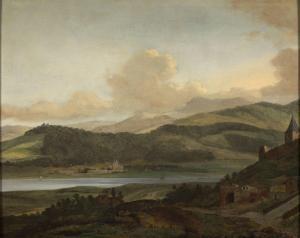
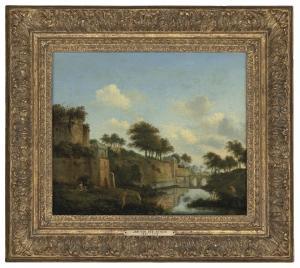
Jan Van Der Heyden - A Wooded Landscape With A Figure In A Park

Jan Van Der Heyden - A Wooded Landscape With A Figure In A Park

Original
Estimate:

Price:

Gross Price
Lot number: 30
Other WORKS AT AUCTION
Description:
A wooded landscape with a figure in a park indistinctly signed 'V.D.H.' (lower right) oil on panel Provenance Seguier collection (according to a label on the reverse). Private collection, Milan. Lot Notes This signed and apparently unrecorded work is sold with a photocopy of a letter written by Dr Helga Wagner, dated 22 February 1973. Wagner notes that the picture belongs to a group of landscapes by van der Heyden that were produced in the 1660s. She compares the close attention to detail in the rendition of the wall, as well as the way in which the foliage is depicted with tiny dotted spots applied with the brush to, for example, the artist's View of a Pavilion near Goudestein , which is dated 1666 (H. Wagner, Jan van der Heyden , Berlin, 1971, p. 94, no. 129); and also to nos. 184, 197 and 203 ( ibid. ). As the label on the reverse of the panel records, this picture was once part of the celebrated collection established by the influential Seguier family, a dynasty of art dealers, advisors, curators, picture restorers and collectors. William Seguier (1771-1843), the descendant of Huguenot emigrés to London, trained as a painter before pursuing a career as connoisseur, becoming one of the first great British art advisors. His clientele included some of the most prominent collectors of the time, such as G. Watson Taylor, Sir Charles Long (later 1st Baron Farnborough), Sir George Beaumont, Sir Robert Peel, the Duke of Wellington and George IV, for whom William Seguier played a key role in building the Royal Collection's inventory of Dutch and Flemish pictures. In deference to Seguier's taste in this field, George IV appointed him Conservator of the Royal Picture Galleries, a post Seguier retained under William IV and Queen Victoria. As a buying agent for so many prominent British collectors, Seguier maintained a close association with Christie's, which was borne out in 1903, when William'’’’’s nephew Frederick Peter Seguier sold part of the family'’’’’s extensive private collection at several Christi'ss auctions, although the present lot does not seem to have been included in these.
Jan Van Der Heyden - Sold By The J. Paul Getty Museum To Benefit Future Painting Acquisitions


          The Inn Of The Zwarte Varcken ('black Pig'), Maarsseveen

Jan Van Der Heyden - Sold By The J. Paul Getty Museum To Benefit Future Painting Acquisitions The Inn Of The Zwarte Varcken ('black Pig'), Maarsseveen

Original
Estimate:

Price: Not disclosed
Lot number: 10
Other WORKS AT AUCTION
Description:
l,u - JAN VAN DER HEYDEN (1637-1712) - SOLD BY THE J. PAUL GETTY MUSEUM TO BENEFIT FUTURE PAINTING ACQUISITIONS THE INN OF THE ZWARTE VARCKEN ('BLACK PIG'), MAARSSEVEEN -
Mis: 18 1/4 by 23 3/4 in.; 46.4 by 60.3 cm.
signed on the upper wooden beam of the lock: VHeyde (VH in compendium) oil on panel

PROVENANCE
Jan van der Heyden (1637-1712) and by inheritance to his wife, Sara Tiel on his death in 1712 (mentioned in the will as "8. de Vegt met de Herberg vant Swarte Varke...80" (8. The Vecht with the Inn of the Black Pig. 80 [guilders]); Sara Tiel, and by inheritance to her son, Samuel van der Heyden, on her death in 1712; Samuel van der Heyden, and then by inheritance to his sister, Sara, on his death in 1729; Sara van der Heyden, and then by inheritance to the husband of her niece, Jan Brants, on her death in 1738; Jan Brants, and by inheritance to his son, Jan Jacob Brants; Jan Jacob Brants, by whom possibly sold to Alexandre Joseph Paillet through Jan de Bosch Jerz.1; Alexandre Joseph Paillet (1743-1814), Paris; His deceased sale, Paris, Paillet, June 2, 1814, lot 8, to A.J.E. Lerouge, for 672 or 677 francs; A.J.E. Lerouge (died 1833); Imported to England by Clifford Waterman Chaplin (a dealer and friend of John Smith) between 1834 and 1842; Private Collection, M. F...; His sale, Paris, Galerie Petit, May 21, 1928, lot 25 ('L'Auberge au bord du canal'), through M. Eknayan to Nicolaas Beets; Nicolaas Beets, Amsterdam, until at least 1935; H.P. Doodeheefver, The Netherlands, by 1937 (according to H. Wagner, see Literature); Herberg van der Wacht; Anonymous sale, London, Sotheby's, June 24, 1959, lot 82 (as 'The Toll House as Maarsen'; the figures attributed to Adriaen van de Velde), where acquired, through Erik Estorick, by J. Paul Getty for £7,800; J. Paul Getty, Sutton Place, Surrey, and donated by his estate to the J. Paul Getty Museum, California, in 1978, no. 78.PB.200.

EXHIBITED
Brussels, Cinq siècles d'art. Exposition Universelle et Internationale, May 24-October 13, 1935, no. 735 ('Auberge au bord du Vescht', where lent by Nicolaas Beets); Amsterdam, Sint Anthoniswaag, Jan van der Heyden: beschrijving van de tentoonstelling in het Amsterdamsch Historische Museum, 1937, no. 8.

REFERENCES
J. Smith, Supplement to the Catalogue Raisonné..., vol. IX, London 1842, p. 647, no. 19; C. Blanc, Le Trésor de la Curiosité, vol. II, Paris 1858, p. 301 (as with figures by Van de Velde); C. Hofstede de Groot, A Catalogue raisonné..., vol. VIII, London 1927, p. 417, no. 319 (The bank of a canal with an Inn...); Probably A. Bredius, "De Nalatenschap van Jan van der Heyden's weduwe", in Oud Holland, 1912, p. 135, no. 8 ('De Vegt met de Herberg vant Swarte Varke'; 'The Vecht with the Inn of the Black Pig'); H. Wagner, Jan van der Heyden 1637-1712, Amsterdam 1971, no. 181 (figures by Van de Velde); G. Schwartz, "Jan van der Heyden and the Huydecopers of Maarsseveen", in The J. Paul Getty Museum Journal, 1983, pp. 197-220; G. Schwartz, "The need for art: a critical view", in Dutch Heights, 1987, p. 25; D. Jaffé, Summary Catalogue of European Paintings in the J. Paul Getty Museum, Los Angeles, 1997, p. 59, reproduced; W.S. Gibson, Pleasant Places: The Rustic Landscape from Brueghel to Ruisdael, Berkeley/ Los Angeles 2000, pp. 109-113, 216 note 105, reproduced plate 7; P.C. Sutton, Jan van der Heyden (1637 - 1712), exhibition catalogue, Bruce Museum, Greenwich 2006, p. 24.

CATALOGUE NOTE
Jan van der Heyden painted fourteen views of Maarssen and its daughter village Maarsseveen in the 1660s and 1670s, yet no other painter is recorded as having worked there. At this time, the lordship of Maarsseveen was held by the second Joan Huydecoper (1625-1704), a member of an extremely powerful family of Amsterdam burgomasters and a great patron of the arts in that city.1 The Huydecopers, who owned the building depicted in the present work, and used it as the administrative seat of their heerlijkleid, or manor,2 turned Maarsseveen from a sleepy farming village into a highly sophisticated country retreat for the Amsterdam rich. Some of Van der Heyden's paintings of the village were no doubt used by the family for propogandist purposes. Van der Heyden painted the Huydecoper's estate at Goudestein on the river Vecht near Maarssen on numerous occasions; see, for example, the view sold New York, Sotheby's, January 12, 1989, lot 118, or that in London, Apsley House, no. 1501. In Amsterdam Huydecoper appointed Van der Heyden supervisor of both streetlighting and, with his brother Nicolaas, of the city fire pumps; as a result the city bought all of its firefighting equipment from the brothers which, together with the large accompanying salaries, rendered their personal wealth considerable. The sign shown on the inn displays the arms of the Maarsseveen and here the local officials would meet to administer justice and law. The exact site is today easily identifiable. Van der Heyden chose the spot where the Vecht joins the Dipendaalse Dijk. The Vecht, seen beyond the inn, bends sharply at this point so that, were the barge directly beneath the sign to start in motion, it would disappear to the right before reappearing in front of the distant stone gate, moving right to left. The vaart in the foreground where the women are washing clothes runs for only a few hundred yards north-eastwards where it joins another canal, the Zogwetering. One of the vaart's functions was to drain water from the Zogwetering to the Vecht, via the lock. Today, in place of the inn stands a house. The lock has been modernised but maintains its old shape, and a road now passes along the bank between the water and the building. The stone gate in the distance, which served as the entrance to Otterspoor or Gansenhoef, no longer exists. 1 According to Gary Schwartz ("Jan van der Heyden and the Huydecopers of Maarsseveen", in The J. Paul Getty Museum Journal, 1983, pp. 198-200), Brants sold at least one other painting by Van der Heyden to Paillet through Jan de Bosch Jerz. (View of the Dam in the Louvre, Paris, for which Paillet paid 6,000 guilders) and so this work may have taken the same route to him. 2 P.C. Sutton, op. cit., p. 24.