Willem Jansz. Van Aelst
TweetFollow the artist with our email alert
Netherlands (1627 - 1683 ) - Artworks Wikipedia® - Willem Jansz. Van Aelst

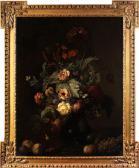
Sotheby's /Dec 5, 2007
€166,112.93 - €249,169.40
Not Sold
Find artworks, auction results, sale prices and pictures of Willem Jansz. Van Aelst at auctions worldwide.
Go to the complete price list of works
Variants on Artist's name :

Willema Van Aelsta

Along with Willem Jansz. Van Aelst, our clients also searched for the following authors:
Pier Francesco Mola, Michiel Jansz. Van Mierevelt, Bernardo Cavallino, Viviano Codazzi, Ciro Ferri, Jacob Toorenvliet, Jacob Adriaensz Backer
Artworks in Arcadja
61Some works of Willem Jansz. Van Aelst
Extracted between 61 works in the catalog of ArcadjaWillem Jansz. Van Aelst - A Partridge, A Pheasant, A Hunting Bag And Traps On A Partiallydraped Ledge, Songbirds, A Hunting Horn And Hawking Hoods Hangingabove
Original 1675
Auction:
Sotheby's -Jan 27, 2011
- New York
Lot number:
142
Other WORKS AT AUCTION
Description:
LOT 142
PROPERTY OF A PRIVATE COLLECTOR
WILLEM VAN AELST
DELFT 1627 - IN OR AFTER 1683 AMSTERDAM (?)
A PARTRIDGE, A PHEASANT, A HUNTING BAG AND TRAPS ON A PARTIALLYDRAPED LEDGE, SONGBIRDS, A HUNTING HORN AND HAWKING HOODS HANGINGABOVE
signed and dated Guill.
mo.
van.Aelst.
1675
oil on canvas
200,000—300,000 USD
26 1/2 by 21 1/2 in.; 67.3 by 54.6 cm.
signed and dated Guill. mo. van.Aelst.
Anonymous sale ('The Property of an Institution'), New York,Christie's, 9 October 1991, lot 200;There purchased by the present collector.
This meticulously rendered gamepiece is a fairly late work byWillem van Aelst. Van Aelst perfected his skill in creating suchhighly refined still lifes during his sojourn to France and Italyfrom 1645 to circa 1655. There he executed works for, among others,the Florentine nobility, gaining the patronage of Ferdinand II de'Medici, Grand Duke of Tuscany. Henceforth he predominantly signedpaintings, including the present one, in Italianate form, as"Guill.mo van Aelst." Van Aelst became the teacher of severaldistinguished still-life painters, including Rachel Ruysch andMaria van Oosterwijck. Samuel van Hoogstraten, a contemporary ofvan Aelst, wrote of his work, "[He] so excelled at art, and copiedso well from life, that his painted works appeared not be apicture, but life itself." Approximately sixty autograph gamepieces are known to have beenexecuted by van Aelst, ranging in date from 1652-1681, far fewer ofwhich depict fowl.1 Furthermore, twelve of thesegamepieces are in public institutions, including the Rijksmuseum,Amsterdam; the Mauritshuis, The Hague; The National Gallery,Washington; the Staatliche Museen, Berlin; the Nationalmuseum,Stockholm; the Statens Museum for Kunst, Copenhagen; and theKunsthalle, Hamburg; a thirteenth belongs to the Sarah CampbellBlaffer Foundation, and is held at the Museum of Fine Arts,Houston; and a fourteenth is in the Princely Collection ofScaumburg-Lippe, at Schloss Bückberg.2 In its crisp brushwork and refined handling, this picture showsthe influence of Otto Marseus van Schrieck (see lot 241), who alsoworked for the Medici in Florence during van Aelst's time there.Compositionally, it is reminiscent of the more ornate banquetpieces executed by Abraham van Beyeren and others from around thistime, and is demonstrated by van Aelst's inclusion of multiplestill life elements, all intertwined and stacked on one another.Enhancing the picture's drama and grand quality is its darkbackground and deep chiaroscuro, which is only further punctuatedby van Aelst's ability to render each still life element withamazing detail. The carefully delineated feathers, juxtaposedagainst the smooth stone ledge and soft velvet tablecloth aretestaments to the artist's careful study of lighting andtexture. 1. S.A. Sullivan, The Dutch Gamepiece, New Jersey 1984, p.52.2. When last sold, this picture was designated as the property ofan institution (see provenance).
Anonymous sale ('The Property of an Institution'), New York,Christie's, 9 October 1991, lot 200;There purchased by the present collector.
This meticulously rendered gamepiece is a fairly late work byWillem van Aelst. Van Aelst perfected his skill in creating suchhighly refined still lifes during his sojourn to France and Italyfrom 1645 to circa 1655. There he executed works for, among others,the Florentine nobility, gaining the patronage of Ferdinand II de'Medici, Grand Duke of Tuscany. Henceforth he predominantly signedpaintings, including the present one, in Italianate form, as"Guill.mo van Aelst." Van Aelst became the teacher of severaldistinguished still-life painters, including Rachel Ruysch andMaria van Oosterwijck. Samuel van Hoogstraten, a contemporary ofvan Aelst, wrote of his work, "[He] so excelled at art, and copiedso well from life, that his painted works appeared not be apicture, but life itself." Approximately sixty autograph gamepieces are known to have beenexecuted by van Aelst, ranging in date from 1652-1681, far fewer ofwhich depict fowl.1 Furthermore, twelve of thesegamepieces are in public institutions, including the Rijksmuseum,Amsterdam; the Mauritshuis, The Hague; The National Gallery,Washington; the Staatliche Museen, Berlin; the Nationalmuseum,Stockholm; the Statens Museum for Kunst, Copenhagen; and theKunsthalle, Hamburg; a thirteenth belongs to the Sarah CampbellBlaffer Foundation, and is held at the Museum of Fine Arts,Houston; and a fourteenth is in the Princely Collection ofScaumburg-Lippe, at Schloss Bückberg.2 In its crisp brushwork and refined handling, this picture showsthe influence of Otto Marseus van Schrieck (see lot 241), who alsoworked for the Medici in Florence during van Aelst's time there.Compositionally, it is reminiscent of the more ornate banquetpieces executed by Abraham van Beyeren and others from around thistime, and is demonstrated by van Aelst's inclusion of multiplestill life elements, all intertwined and stacked on one another.Enhancing the picture's drama and grand quality is its darkbackground and deep chiaroscuro, which is only further punctuatedby van Aelst's ability to render each still life element withamazing detail. The carefully delineated feathers, juxtaposedagainst the smooth stone ledge and soft velvet tablecloth aretestaments to the artist's careful study of lighting andtexture. 1. S.A. Sullivan, The Dutch Gamepiece, New Jersey 1984, p.52.2. When last sold, this picture was designated as the property ofan institution (see provenance).
Willem Jansz. Van Aelst - Still Life Of Game With A Pheasant
Original 1654
Auction:
Sotheby's -Apr 22, 2009
- London
Lot number:
26
Other WORKS AT AUCTION
Description:
LOT 26
WILLEM VAN AELST
DELFT 1627 - IN OR AFTER 1683 AMSTERDAM (?)
STILL LIFE OF GAME WITH A PHEASANT, A DUCK, A KINGFISHER AND OTHER BIRDS
20,000—30,000 GBP
measurements note
46.5 by 37 cm.; 18 1/4 by 14 1/2 in.
DESCRIPTION
signed and dated upper right: w.v.aelst/ 1654
oil on copper
PROVENANCE
Lucien Bonaparte, Prince de Canino, (1775-1840), by 1812.
LITERATURE AND REFERENCES
Galerie de Lucien Bonaparte, Paris 1812, p. 2, no. 32, plate 132; B. Edelein-Badie, La collection de tableaux de Lucien Bonaparte, Prince de Canino
, Phd Dissertation 1992, University Paul Valéry de Montpellier, vol. II, pp. 220, no. 1; M. Natoli ed., Luciano Bonaparte: le sue collezioni d'arte, le sua residenze a Roma, nel Lazio, in Italia, 1804-1840
, Rome 1995, p. 353, no. 197.
CATALOGUE NOTE
We are grateful to Fred G. Meijer for endorsing the attribution on the basis of photographs.
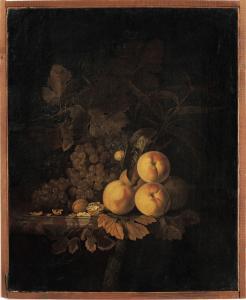
Willem Jansz. Van Aelst - Plums, Strawberries, Peaches, Grapes, Redcurrants And Gooseberries With A Finch, On A Partly-draped Marble Ledge
Original
Auction:
Christie's -Apr 25, 2008
- London
Lot number:
27
Other WORKS AT AUCTION
Description:
Plums, strawberries, peaches, grapes, redcurrants and gooseberries with a finch, on a partly-draped marble ledge oil on panel 16 1/8 x 12¾ in. (40.9 x 32.4 cm.) Provenance with Galerie Meissner, Zurich, from whom acquired by the following Anonymous sale [The Property of a Gentleman]; Sotheby's, London, 10 April, 2003, lot 55, when acquired by the present owner. Lot Notes The attribution was first proposed by Walther Bernt, and has been confirmed by Fred Meijer of the RKD, The Hague. Whilst Bernt suggested that the picture is an early work, dating it from around 1645, Meijer has suggested that it is closer to 1649, noting that a similar work, dated 1649, is now in the Prinsenhof Museum, Delft (formerly in the collection of Professor Einar Perman, Stockholm; see I. Bergstrom, Dutch Still-Life painting in the 17th Century , New York, 1983, p. 218, fig. 183, incorrectly recorded as dated 1646).
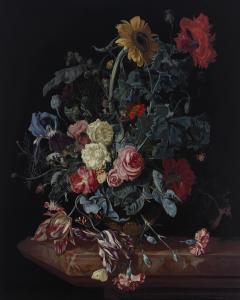
Willem Jansz. Van Aelst - Still Life With A Bouquet Of Flowers On A Marble Table Top
Original 1666
Auction:
Sotheby's -Dec 5, 2007
- London
Lot number:
41
Other WORKS AT AUCTION
Description:
signed and indistinctly dated lower left:
Guill.
mo
v... Aelst. 1666
oil on canvas
PROVENANCE
Guy Argles Esq.; Anonymous sale, London, Sotheby's, 2 December 1964, lot 23; With Richard Green, London, from whom acquired by the present owner.
LITERATURE AND REFERENCES
Advertisment in The Burlington Magazine, vol. CVI, no. 740, November 1964, p. xii, reproduced.
CATALOGUE NOTE
This is a typical and highly finished work of the 1660s by Willem van Aelst. By the time he painted the present still life he had settled in Amsterdam for nine years, having been brought up and trained in Delft, probably by his uncle Evert van Aelst (1602-57), where he entered the painters guild in 1643. His peripatetic youth next took him to France, from 1645 to 1649, and then until 1656 he worked in Florence as court painter to Ferdinando II de' Medici, Grand Duke of Tuscany. Here he met and worked closely with Otto Marseus van Schrieck with whom he returned to Delft in 1656, before settling in Amsterdam the following year. It was during and after his Italian sojourn that he began to sign paintings, including this one, with the italianate form of his name, 'Guill.mo van Aelst'. He became the teacher of several notable still-life painters, including Rachel Ruysch and Maria van Oosterwijk, and was held in great esteem both during and after his lifetime; Samuel van Hoogstraaten, a contemporary, writing of him, "[He] so excelled at art, and copied so well from life, that his painted works appeared not to be a picture, but life itself."
Willem Jansz. Van Aelst - Still Life With A Roemer, A Carafe Of Vinegar, A Glass Tazza, A Bread Roll And Oysters On A Silver Plate On A Draped Table Top
Original 1675
Auction:
Sotheby's -Jan 26, 2007
- New York
Lot number:
19
Other WORKS AT AUCTION
Description:
WILLEM VAN AELST (1627-1683/86) - STILL LIFE WITH A ROEMER, A CARAFE OF VINEGAR, A GLASS TAZZA, A BREAD ROLL AND OYSTERS ON A SILVER PLATE ON A DRAPED TABLE TOP -
Mis: 16 by 13 3/4 in.; 40.5 by 35 cm.
signed and dated top left: Guill.mo van Aelst. 1675 oil on canvas
PROVENANCE
Winter Collection, Vienna; Baron August Stummer von Tavernock, Vienna; Dr. C.J.K. van Aalst, Huiste Hoevelaken, near Amersfoort, 1938 - 1981, His sale, Mak van Waay, Amsterdam, May 18, 1981, lot 2, illus.; With David Koetser, Zurich, 1982; Private collection, Germany.
EXHIBITED
Dordrecht Museum, Niederländische Stilleben aus 4 Jahrhunderten, 1954, no. 2.; 'Glück und Glas - zur Kulturgeschichte des Spessartglases,' Lohr & Dortmund 1984, no. 27, in Claus Grimm sale catalogue, pp. 355 - 58, pl. 244.
REFERENCES
JW Moltke, Dutch and Flemish Old Masters in the Collection of Dr CJK van Aalst, Verona 1939, p.46, pl. X.
CATALOGUE NOTE
This still life of oysters, wine glasses and a carafe of (most probably) vinegar is a fairly late work by the artist. Van Aelst started to paint such smaller still lifes of exquisite victuals on his return to the Netherlands after living in France and Italy from 1645 to circa 1655. There he had developed his luxury still lifes for, among others, the Florentine nobility, gaining the patronage of Ferdinand II de' Medici, Grand Duke of Tuscany. Henceforth he often proudly signed paintings, including this one, in Italianate form, as 'Guill.mo van Aelst.' Van Aelst became the teacher of several distinguished still-life painters, including Rachel Ruysch and Maria van Oosterwijk. Samuel van Hoogstraten, a contemporary of van Aelst, wrote of his work, "[He] so excelled at art, and copied so well from life, that his painted works appeared not to be a picture, but life itself." A fairly early example, which is nevertheless similar in style and atmosphere, is the painting from 1657 in Copenhagen (Statens Museum for Kunst, inv.no. 379), which features a similar, or perhaps even the same glass tazza and silver platter. Even in such relatively simple compositions, Willem van Aelst was able to summon up an air of refinement and luxury, mainly by his masterful command of lighting and texture. He spent most of his career exploiting the juxtaposition of different textures in his paintings: the softness of the velvet tablecloth next to the sheen of the silver plate and the slick texture of the oysters, and the crunchy-soft bread embraced by the various types of reflections in the glass containers and the silver pepper box. A somewhat later example, dated 1679, from the collection of the Gemäldegalerie Alte Meister in Dresden, is also comparable in atmosphere and subject matter. This catalogue note is based on a report by Fred G. Meijer of the Rijksbureau voor Kunsthistorische Documentatie, The Hague.
Mis: 16 by 13 3/4 in.; 40.5 by 35 cm.
signed and dated top left: Guill.mo van Aelst. 1675 oil on canvas
PROVENANCE
Winter Collection, Vienna; Baron August Stummer von Tavernock, Vienna; Dr. C.J.K. van Aalst, Huiste Hoevelaken, near Amersfoort, 1938 - 1981, His sale, Mak van Waay, Amsterdam, May 18, 1981, lot 2, illus.; With David Koetser, Zurich, 1982; Private collection, Germany.
EXHIBITED
Dordrecht Museum, Niederländische Stilleben aus 4 Jahrhunderten, 1954, no. 2.; 'Glück und Glas - zur Kulturgeschichte des Spessartglases,' Lohr & Dortmund 1984, no. 27, in Claus Grimm sale catalogue, pp. 355 - 58, pl. 244.
REFERENCES
JW Moltke, Dutch and Flemish Old Masters in the Collection of Dr CJK van Aalst, Verona 1939, p.46, pl. X.
CATALOGUE NOTE
This still life of oysters, wine glasses and a carafe of (most probably) vinegar is a fairly late work by the artist. Van Aelst started to paint such smaller still lifes of exquisite victuals on his return to the Netherlands after living in France and Italy from 1645 to circa 1655. There he had developed his luxury still lifes for, among others, the Florentine nobility, gaining the patronage of Ferdinand II de' Medici, Grand Duke of Tuscany. Henceforth he often proudly signed paintings, including this one, in Italianate form, as 'Guill.mo van Aelst.' Van Aelst became the teacher of several distinguished still-life painters, including Rachel Ruysch and Maria van Oosterwijk. Samuel van Hoogstraten, a contemporary of van Aelst, wrote of his work, "[He] so excelled at art, and copied so well from life, that his painted works appeared not to be a picture, but life itself." A fairly early example, which is nevertheless similar in style and atmosphere, is the painting from 1657 in Copenhagen (Statens Museum for Kunst, inv.no. 379), which features a similar, or perhaps even the same glass tazza and silver platter. Even in such relatively simple compositions, Willem van Aelst was able to summon up an air of refinement and luxury, mainly by his masterful command of lighting and texture. He spent most of his career exploiting the juxtaposition of different textures in his paintings: the softness of the velvet tablecloth next to the sheen of the silver plate and the slick texture of the oysters, and the crunchy-soft bread embraced by the various types of reflections in the glass containers and the silver pepper box. A somewhat later example, dated 1679, from the collection of the Gemäldegalerie Alte Meister in Dresden, is also comparable in atmosphere and subject matter. This catalogue note is based on a report by Fred G. Meijer of the Rijksbureau voor Kunsthistorische Documentatie, The Hague.