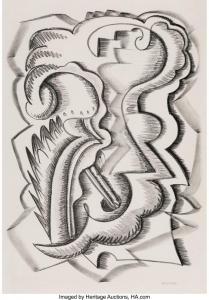
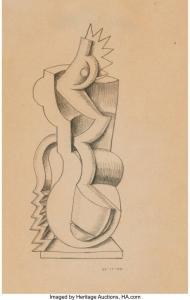
John Henry Bradley Storrs
TweetFollow the artist with our email alert
(1885 - 1956 ) - Artworks Wikipedia® - John Henry Bradley Storrs

Adams /Oct 7, 2008
€10,000.00 - €15,000.00
€80,000.00
Find artworks, auction results, sale prices and pictures of John Henry Bradley Storrs at auctions worldwide.
Go to the complete price list of works
Along with John Henry Bradley Storrs, our clients also searched for the following authors:
Marguerite Thompson Zorach, Gaston Lachaise, John Jesse Francis, John Marin, Luigi Lucioni, Milton Clark Avery, Jacob Lawrence
Artworks in Arcadja
24Some works of John Henry Bradley Storrs
Extracted between 24 works in the catalog of ArcadjaJohn Henry Bradley Storrs - Howard E. Smith
Original
Auction:
Christie's -Feb 27, 2013
- New York
Lot number:
64
Other WORKS AT AUCTION
Description:
Lot Description
John Henry Bradley Storrs (1885-1956)
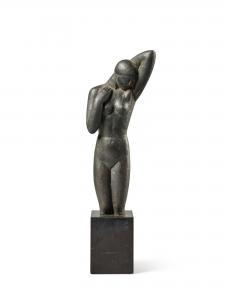
'Howard E. Smith'
inscribed 'To/My Friend - HOWARD E. SMITH -' and '6/-12/13-' and stamped 'C. VALSUANI CIRE PERDUE' (on the base)
bronze with brown patina
14¼ in. (36.2 cm.) high on a 2 in. (5.1 cm.) wood base
Provenance
[With]Robert Schoelkopf Gallery, New York, by 1980. Private collection, New York. Gift to the present owner from the above.
Pre-Lot Text
PROPERTY OF A DISTINGUISHED NEW YORK COLLECTOR
Literature
Sterling and Francine Clark Institute, John Storrs & John Flannagan, Sculpture & Works on Paper, exhibition catalogue, Williamstown, Massachusetts, 1980, pp. 12, 48, no. 1, illustrated (as 'Howard E. Smith, (Boy with Cape)'). N. Frackman, John Storrs, exhibition catalogue, New York, 1986, pp. 19, 137, fig. 4, illustrated.
Exhibited
Williamstown, Massachusetts, Sterling and Francine Clark Art Institute, John Storrs & John Flannagan: Sculpture & Works on Paper, November 7-December 28, 1980. New York, Whitney Museum of American Art, John Storrs, December 11, 1986-March 22, 1987.
John Henry Bradley Storrs - Abstract Sculpture
Original 1930
Auction:
Sotheby's -May 19, 2011
- New York
Lot number:
40
Other WORKS AT AUCTION
Description:
LOT 40
PROPERTY FROM A PRIVATE COLLECTION, MIDDLEBURG,VIRGINIA
JOHN BRADLEY STORRS
1885 - 1956
ABSTRACT SCULPTURE
inscribed Storrs, with the cast by Am-Art Bronze Fdy Chicagofoundry mark
bronze, dark brown patina
250,000—350,000 USD
height: 17 1/2 in.
inscribed Storrs, with the cast by Am-Art Bronze Fdy Chicagofoundry mark
bronze, dark brown patina
Executed circa 1930.
The Downtown Gallery, New YorkZabriskie Gallery, New YorkPrivate Collection, Providence, Rhode Island, 1973 (acquired fromthe above)By descent in the family to the present owner (her son)
New York, The Whitney Museum of American Art; St. Louis,Missouri, City Art Museum of St. Louis; Cleveland, Ohio, ClevelandMuseum of Art; Philadelphia, Pennsylvania, Pennsylvania Academy ofthe Fine Arts; Chicago, Illinois, Art Institute of Chicago;Buffalo, New York, Albright-Knox Art Gallery, The Decade of theArmory Show: New Directions in American Art 1910-1920, February1963-February 1964, no. 100, illustrated p. 63Providence, Rhode Island, Museum of Art, Rhode Island School ofDesign, 1900 to Now: Modern Art From Rhode Island Collections,January-May 1988, illustrated p. 52 (as Horse)
Edith Halpert, Archives of American Art online photograph files,Box 114, Reel 5652, frame 1038-39
We are grateful to Debra Bricker Balken for preparing thefollowing essay. Ms. Balken is an independent curator and writerwho works on American modernism. Most recently, she has curatedJohn Storrs: Machine-Age Modernist, an exhibition which iscurrently installed at the Grey Art Gallery, New York Universitythrough July 9, 2011.John Storrs was one of the foremost modernist sculptors to emergein the United States in the early twentieth century. An artist whodivided his time between Chicago, Paris and the Loire Valley duringthe decade of the 1920s, Storrs was situated at the forefront of aninternational avant-garde community. While a favored student ofAuguste Rodin in 1913, he quickly moved beyond the modeled,textured surfaces that his erstwhile mentor had favored andapproached form as a planar affair, while reducing the body to anangular, architectonic structure. Moreover, unlike the heightenedemotion associated with Rodin's figures, Storrs dispensed withsentiment and tackled the figure with reserve. His subjects werealways rendered with a certain restraint that underscored his morepressing interest in advancing the prevailing languages ofmodernism.Storrs had grown up in Chicago, where his father became a prominentreal estate developer and landlord. He was home-schooled but laterattended the University High School, a division of the Universityof Chicago whose progressive curriculum had been shaped by JohnDewey. In 1908, after extensive travel abroad, he enrolled in nightclasses at the Art Institute of Chicago. During this period, heworked in his father's office in The Rookery on LaSalle Streetwhere it was anticipated that his considerable talents as adraftsman would eventually be put to use. He soon became bored,however, by the tedium of collecting rents â his assignedresponsibility â and bolted for further study at art schools inBoston and Philadelphia, experiences that were equally stifling forhim. Yet, The Rookery, which had been designed by Burnham and Rootin 1885 - 88, had its lobby reconfigured in 1905 by one of itsformer tenets, Frank Lloyd Wright, who clothed its once ornate castiron columns with large sheets of plain white marble, effectivelysubverting the profusion of textured surfaces on the exterior. Thecontrast must have striking to Storrs as he walked through thesesimplified spaces on a daily basis. Later, as he set up practice asan artist in Paris, he began to rethink Wright's spare use ofdecoration. Eventually, in the early 1920s, he produced a series ofwhite columnar-type sculptures in stone in which the embellishmentconsists of geometric patterning reminiscent of the localizeddetail in Wright's signature Prairie Architecture. These verticalshafts,
We are grateful to Debra Bricker Balken for preparing thefollowing essay. Ms. Balken is an independent curator and writerwho works on American modernism. Most recently, she has curatedJohn Storrs: Machine-Age Modernist, an exhibition which iscurrently installed at the Grey Art Gallery, New York Universitythrough July 9, 2011.John Storrs was one of the foremost modernist sculptors to emergein the United States in the early twentieth century. An artist whodivided his time between Chicago, Paris and the Loire Valley duringthe decade of the 1920s, Storrs was situated at the forefront of aninternational avant-garde community. While a favored student ofAuguste Rodin in 1913, he quickly moved beyond the modeled,textured surfaces that his erstwhile mentor had favored andapproached form as a planar affair, while reducing the body to anangular, architectonic structure. Moreover, unlike the heightenedemotion associated with Rodin's figures, Storrs dispensed withsentiment and tackled the figure with reserve. His subjects werealways rendered with a certain restraint that underscored his morepressing interest in advancing the prevailing languages ofmodernism.Storrs had grown up in Chicago, where his father became a prominentreal estate developer and landlord. He was home-schooled but laterattended the University High School, a division of the Universityof Chicago whose progressive curriculum had been shaped by JohnDewey. In 1908, after extensive travel abroad, he enrolled in nightclasses at the Art Institute of Chicago. During this period, heworked in his father's office in The Rookery on LaSalle Streetwhere it was anticipated that his considerable talents as adraftsman would eventually be put to use. He soon became bored,however, by the tedium of collecting rents â his assignedresponsibility â and bolted for further study at art schools inBoston and Philadelphia, experiences that were equally stifling forhim. Yet, The Rookery, which had been designed by Burnham and Rootin 1885 - 88, had its lobby reconfigured in 1905 by one of itsformer tenets, Frank Lloyd Wright, who clothed its once ornate castiron columns with large sheets of plain white marble, effectivelysubverting the profusion of textured surfaces on the exterior. Thecontrast must have striking to Storrs as he walked through thesesimplified spaces on a daily basis. Later, as he set up practice asan artist in Paris, he began to rethink Wright's spare use ofdecoration. Eventually, in the early 1920s, he produced a series ofwhite columnar-type sculptures in stone in which the embellishmentconsists of geometric patterning reminiscent of the localizeddetail in Wright's signature Prairie Architecture. These verticalshafts, variously titled, Study in Form and ArchitecturalForms , are among the most radical, modernist statements ofearly twentieth century art. As lean, free-standing works, they arealso elegant abstractions of the American Machine-Age and itsquintessential icon: the Skyscraper.By the early 1920s, Storrs worked in a variety of media. Outside oflimestone, marble and bronze, he was also drawn to sleek industrialmetals such as stainless steel, copper and brass, the latter ofwhich he fashioned into sculptures around 1925 that represented thenew, towering architecture of Manhattan, a place that he visited,along with Chicago, periodically throughout the decade. He soonclustered stacks of contrasting, shiny metals into seeminglyrecognizable, albeit faux, Art Deco buildings such as NewYork , c. 1925, in which decoration was constrained and reducedto a minimum. It was in New York that Storrs met artists such asMarcel Duchamp, Man Ray, Charles Sheeler and Joseph Stella, figureswith whom he exhibited at Katherine Dreier's Societe Anonyme, oneof the first showcases for international vanguard art in the UnitedStates, and a venue for Dada activities. But unlike Man Ray, whosatirized the streamlined forms of the skyscraper in an assemblage,New York , 1917, which consisted of six chrome-plated bronzeand brass strips held together by a C-clamp, Storrs was disaffectedwith Dada and its provocations and jest. Rather than a condemnationof a burgeoning consumerist culture and industry, his soaring metaltowers are an affirmation of American industry. And even thoughStorrs conceived these architectonic emblems abroad, they emerge aspart of his ongoing anticipation that Manhattan could become "theworld's art center." He might have chosen France as his base, buthe remained identified with American culture and the example offigures such as Frank Lloyd Wright.Storrs was, in fact, enthralled with Machine-Age technology, and inparticular its American expressions. Like numerous contemporaries,including French colleagues such as the architect and painter LeCorbusier, he was intrigued by new materials and utilized them inhis work. However, unlike Corbusier, and his notion of formalpurity, he aimed to preserve decorative features in his work Forall of their overlapping interest, he was continuously drawn, likeWright, to the craft of art, to its core beauty, and stated, "Ahighly finished craftsmanship or technique is a beautiful tool inthe hands of a master. It has never been a hindrance to a realartist." As such, Abstract Sculpture , c. 1930, extendsStorrs abiding interest in merging craft with decorative, abstractfeatures. Therein, with its asymmetrical rendering of striatedpatterns, and fragmented face, he treats the image as a robust ArtDeco entity. As a subject, Storrs had been drawn to the horse sincethe early 1910s, when he mined Pegasus, a symbol of inspiration, asa theme in numerous prints, drawings and sculptures. Whatever hisattraction to the new automated culture of the 1920s, the horseremained a potent, vital emblem for him, in which he situated "horse power" as a precursor to mechanized vehicles such as the carand airplane. He has also used the winged horse to represent WaltWhitman, his favorite American poet, a figure whom he touted as "asincere and complete expression of our soul of the United States."Abstract Sculpture , then, is part of a vital series of worksthat both parallel and amplify his attraction to new modernistforms such as the skyscraper.
John Henry Bradley Storrs - Two Figures
Original 1917
Lot number:
123
Other WORKS AT AUCTION
Description:
John Storrs
American, 1885-1956
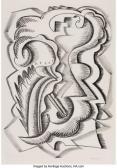
Two Figures
, 1917
Initialed
JS
and dated
5.11.17
(lr)
Ink on paper
10 x 6 3/4 inches (25.4 x 17.1 cm)
Provenance:
Estate of the artist, no. JS 112
Valerie Carberry Gallery, Chicago, Illinois
Robert Henry Adams Fine Art, Chicago, Illinois
Property of a Gentleman
Estimate $3,000-5,000
Minor tonign along left extreme edge. Very good condition.
John Henry Bradley Storrs - Study In Pure Form
Original 1924
Auction:
Adams -Oct 7, 2008
- Dublin
Lot number:
44
Other WORKS AT AUCTION
Description:
Study in Pure Form
Carved stone and black enamel, 42.5cm high
Signed and dated 1924 on the base
Provenance: From the Estate of Anne Bullitt, having previouslybelonged to her Father William C. Bullitt, diplomat, journalist andnovelist, who was appointed first U.S Ambassador to The SovietUnion in 1933. In his varied career William Bullitt wrote a numberof important texts including a psycholgical study of ThomasWoodrown Wilson written in conjuction with Sigmund Freud.
Modernist sculptor John Bradley Storrs was born in Chicago in 1885.During his teens he studied at the Chicago Manuel Training School,where he worked with sculptural material for the first time. Storrswent on to study in Paris at the Academie Franklin, the BostonSchool of the Museum of Fine Art, the Pennsylvania Academy of Artsand finally again in Paris with Auguste Rodin. Having travelledextensively throughout Europe and Egypt, Storrs developed his ownstyles from numerous diverse sources, most notably Ancient Greekand Egyptian sculpture, Native American geometric art and design,and the modern European movements Cubism, Futurism, Vorticism andArt Deco. Although he worked with a number of materials includingbronze and terracotta, it is in his stone sculptures, often withenamel inlay, that all of his influences come together, with cleandynamic lines, solid forms, and stylised patterns the prominentfeatures.
Storrs' work will be known to an Irish audience through his reliefsculpture of Christ the King which adorns the facade of the churchby the same name in Turners Cross, Cork. The unusual Art Deco stylechurch was designed by Chicago architect Barry Byrne, who hadpurchased a number of works from Storrs in Paris in 1925. Storrsworked on drawings for the figure of Jesus and visited the site inCork in 1929 before making a number of scale models. The reliefitself was executed by Cork sculptor John Maguire, based on Storrs'plaster models which had been shipped from France.
John Henry Bradley Storrs - 'le Sergent De Ville (gendarme)' A Bronze Sculpture
Original 1920
Auction:
Christie's -Dec 19, 2006
- New York
Lot number:
555
Other WORKS AT AUCTION
Description:
Lot Description
JOHN STORRS (1885-1956)
'Le Sergent de Ville (Gendarme)' A Bronze Sculpture, circa 1920
13½ in. (34.3 cm.) high
monogrammed JS
Lot Notes
N. Frackman et al., exhibition catalogue, John Storrs, New York, The Whitney Museum of American Art, 1986, p. 52, ill. 50, for an illustration of a sculpture of this model.
Work by Storrs is in the collection of the Art Institute of Chicago, The Whitney Museum of American Art, New York, The Metropolitan Museum of Art, New York and The Museum of Modern Art, New York. This bronze was cast in 1952 in an edition of three and authorized by the Storrs family. The unique bronze cast in 1920 is in the collection of the Corcoran Gallery of Art Washington, D.C.