Art Auctions - English Language Aste Arte - Lingua Italiana Subastas Arte - Langue Espagnole Ventes aux Encheres Art - Langue Française Kunstauctionen - Deutsch Leilões de Arte - Português Аукционы искусства - Руссо الفن المزادات - العربية
Register - Resend Password
Arcadja Auctions

Pietro Antonio Rotari

Follow the artist with our email alert
Italy (Verona 1707San Pietroburgo 1762 ) - Artworks Wikipedia® - Pietro Antonio Rotari
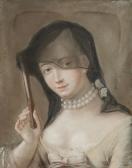
ROTARI Pietro Antonio Portrait Of A Young Man In A Powdered Wig

Sotheby's /Jan 24, 2008
10,229.83 - 13,639.77
23,329.22
Find artworks, auction results, sale prices and pictures of Pietro Antonio Rotari at auctions worldwide.
Go to the complete price list of works


Artworks in Arcadja
115

Some works of Pietro Antonio Rotari

Extracted between 115 works in the catalog of Arcadja
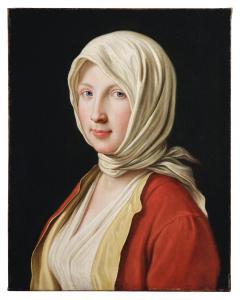
Pietro Antonio Rotari - Young Woman In A Red Fur-trimmed Coat

Pietro Antonio Rotari - Young Woman In A Red Fur-trimmed Coat

Original
Estimate:

Price:

Gross Price
Lot number: 640
Other WORKS AT AUCTION
Description:
Pietro Antonio Rotari (Verona 1707–1762 St. Petersburg) Young Woman in a Red Fur-Trimmed Coat, oil on canvas, 45 x 35 cm, framed Provenance: Othon Kaufmann and François Schlageter Collection, Strasbourg (according to a collector’’’’s mark on reverse); Private European collection (purchased by the present owner in 1984) The present portrait is one of the paintings of young women which gained Rotari his reputation throughout Europe. The artist executed many such studies of heads for the courts in Dresden, Vienna and St. Petersburg, equally interesting in their sentiment and painterly brilliance. In these portraits the artist portrays human passion with subtle colouring and sensitive observation. Pietro Rotari came from a noble family and initially began to study painting only as a pastime. He was taught by Antonio Balestra in Verona, and later travelled to Venice and Rome where he became a pupil of Francesco Trevisani. From 1731 to 1734 he worked in the studio of Francesco Solimena in Naples. After returning to Verona he set up his own studio and earned himself a reputation as a painter of altarpieces, rich in figures and inspired by the influence of Roman and Neapolitan painters of the 17th century. He travelled to Vienna around 1751, and here he was able to study the works of Jean-Etiénne Liotard whose clear, painterly smoothness impressed him and had a lasting influence on his subsequent works. After a stay in Dresden his reputation lead him to Russia, where his portraits enjoyed great success and he was appointed court painter to Czarina Elizabeth l. Rotari received a commission to paint portraits of young women for the gallery of beauties which were intended to represent the diversity of the Russian peoples. In the course of this commission Rotari produced not only 360 pictures of Russian middle-class ladies for Elizabeth, but also an additional 50 which she presented to the Russian Academy of Art. Elizabeth’’’’s pictures were earmarked for the Peterhof Palace, and today around 40 of the works are to be found in the palace in Archangel. The charm of these portraits often approaches that of Greuse or Chardin. Round collector’’’’s marks (see fig.1) on the reverse of the stretcher indicates the provenance of the present painting as the collection of Othon Kaufmann and François Schlageter, a renowned private collection which was given to the Louvre, Paris in 1983. The present work was possibly sold prior to this date. The Kaufmann and Schlageter collection included important works of the highest quality, bought on the advice of Hermann Voss and Pierre Rosenberg. Resident in Strasburg, the collectors were self-taught and had already begun to acquire the most eclectic range of objets d’’’’art before the First World War. They owned many Italian paintings.
Pietro Antonio Rotari - Portrait Of A Young Woman

Pietro Antonio Rotari - Portrait Of A Young Woman

Original
Estimate:

Price:

Net Price
Lot number: 631
Other WORKS AT AUCTION
Description:
DescEN Rotari, Pietro Antonio 1707 Verona - 1762 St. Petersburg Portrait of a Young Woman. Oil on canvas, mounted on wood. 44.5 x 35cm. Framed. "As a historical painter and independant from his teachers Trevisani and Solimena, Rotari developed a unique, if slightly monotonous, portrait style. This manner embues the subjects with a marionette-like quality, and had no small influence on the painter's Russian students Argunoff, Antropoff and Rokotoff. Especially charming are the portraits of girl's faces representing the various peoples of Russia, of which Rotari produced hundreds at the request of the Zarin." Raffaello Brenzoni: Pietro Antonio Rotari. In: Thieme, Ulrich; Becker, Felix: Allgemeines Lexikon der bildenden K├╝nstler. 29. Volume. Leipzig 1935. Pg. 82f.
Pietro Antonio Rotari - A Young Woman

Pietro Antonio Rotari - A Young Woman

Original
Estimate:

Price:

Gross Price
Lot number: 163
Other WORKS AT AUCTION
Description:
Pietro Rotari (Verona 1707-1762 Saint Petersburg) A young woman, half-length, in rural dress, playing a lute oil on canvas 28¾ x 23¼ in. (73 x 59 cm.) This coquettish figure is typical of the paintings of villiagers and peasants that Rotari executed while working as court painter for Elizabeth, Empress of Russia. Catherine the Great's cabinet of 'Muses and Graces' at the Peterhof Palace is virtually upholstered with over three hundred of these works.
Pietro Antonio Rotari - Portrait Of A Young Man In A Powdered Wig

Pietro Antonio Rotari - Portrait Of A Young Man In A Powdered Wig

Original
Estimate:

Price:

Gross Price
Lot number: 381
Other WORKS AT AUCTION
Description:
oil on canvas CATALOGUE NOTEThis portrait was traditionally thought to portray Catherine the Great of Russia in men's garb. The clothing, however, suggests an earlier period, perhaps 1740-50. It has been suggested that this may be a portrait of Elizabeth I Petrovna, Catherine's mother-in-law, who was known for wearing men's clothing frequently, and for her cross-dressing balls and dinners in Saint Petersburg.
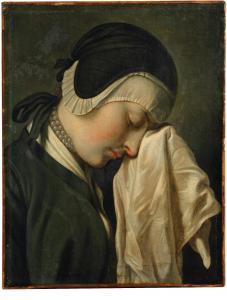
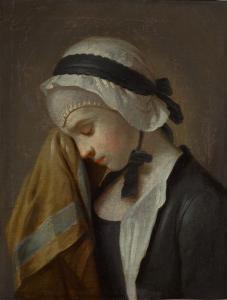
Pietro Antonio Rotari - A Sleeping Young Girl

Pietro Antonio Rotari - A Sleeping Young Girl

Original
Estimate:

Price:

Lot number: 301
Other WORKS AT AUCTION
Description:
Pietro Antonio Rotari (Verona 1707-1762 Saint Petersburg) A sleeping young girl inscribed with the collector's cypher of Prins von Kaunitz-Rietberg (lower right) oil on canvas 17½ x 13¾ in. (44.5 x 35 cm.) Lot Notes Pietro Rotari studied first in his native Verona with Antonio Balestra before setting off in 1727 for Rome and Naples, where he entered first the studio of Francesco Trevisani and then Francesco Solimena. He returned to his hometown in 1734 where he opened a private academy. There, he concentrated on the production of the historical and religious paintings which were to bring him international fame. In 1740, Rotari was awarded the title of Count of the Venetian Republic in recognition of his achievements. The following year he traveled to Vienna, where he met Jean-Etiènne Liotard, the Swiss pastellist, whose work profoundly influenced him. Rotari was in Dresden in the service of Frederick Augustus III when he received an invitation from the Empress Elisabeth of Russia, daughter of Peter the Great, to come to St. Petersburg as first painter of the court. He arrived in Russia in 1756 and soon amassed a large fortune: a visit to his richly appointed house on the Bolsciasia Morskaia was obligatory for high-ranking visitors to the city. Although he continued to work as a history painter in Saint Petersburg, it was there that Rotari developed the genre still associated with his name: small paintings of idealized heads, delicate and studiously artless in style, depicting the emotions of young boys and girls. It would appear that virtually all of these heads were executed during the six-year period between Rotari's arrival in Russia and his death in 1762. Using a minimum of props - a closed fan, a sprig of jasmine, an open book, or, as here, none at all, Rotari presented absorbed reverie, timid surprise, or relaxed sleep, to the delight of his contemporaries. After Rotari's sudden death, Catherine the Great bought 340 of the artist's 'fancy pictures' for the salon of Peterhof, where small and large canvases are arranged in a careful pattern across the walls above and between intricately carved rococo doors and mirrors (figs. 1 & 2). A version of the present painting, with differences, hangs at Peterhof. Those pictures that Catherine did not buy were returned to Rotari's family in Verona, where they remained in the possession of his descendants until the late nineteenth century. The present painting belonged to one of the great collectors of eighteenth century Europe, Wenzel Anton, Prince von Kaunitz-Rietberg (1711-1794), who lived at Kaunitz Stadtpalais, Dorotheergasse, Vienna, and whose cypher is stenciled on the lower right corner of the present painting (fig. 3). The son of an Austrian count, Kaunitz rose through a diplomatic career in Italy, the Netherlands and Paris to become Chancellor of Austria in 1753. In that office he became and remained the closest confidant of the Empress Maria Theresa (by whom he was made a prince in 1764) and was the single most important force behind Austria's intellectual, political and domestic development until 1792. Enlightened, broad-minded and acutely intelligent, he made a decisive mark on his era. A highly cultured man, and a key figure in the Austrian Enlightenment, Kaunitz was convinced of the value of the arts for the economic and moral development of the state, and went to great lengths to promote Austria's artistic and cultural growth. In 1766 he opened the Kupferstichakademie in Vienna, established by Jakob Matthias Schmutzer (1733-1811). In 1772 this was combined with the Akademie der Maler, Bildhauer und Baukünstler and the Graveurakademie to form the Akademie der Bildenden Künste, under Kaunitz's protection. In addition, he improved public training for artists and encouraged the free development of the Akademie students' creative abilities. He fostered many artists personally, including Franz Anton Zauner, Heinrich Friedrich Füger and Ignaz Unterberger, often awarding pensions for foreign study. Kaunitz's considerable art collection, which was dispersed between 1820-30, was housed in his palace in Vienna, and included a huge cabinet of prints as well as Rembrandt's Study of an elderly woman in a white cap (sold, Sotheby's, New York, 26 January 2006, lot 10).