Nicholaos Lytras
TweetFollow the artist with our email alert
Greece (1883 - 1927 ) - Artworks

Sotheby's /May 9, 2011
€9,004.45 - €13,506.67
Not Sold
Find artworks, auction results, sale prices and pictures of Nicholaos Lytras at auctions worldwide.
Go to the complete price list of works
Along with Nicholaos Lytras, our clients also searched for the following authors:
Alecos, Alex Kontopoulos, Constantinos Volanakis, Emilios Prosalentis, Pavlo Prosalentis, Périclès Pantazis, George Edwards Hering, Konstantinos Maleas
Artworks in Arcadja
29Some works of Nicholaos Lytras
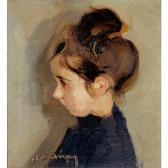
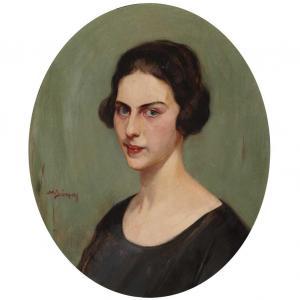
Extracted between 29 works in the catalog of ArcadjaNicholaos Lytras - Portrait Of A Woman
Original
Lot number:
46
Other WORKS AT AUCTION
Description:
Lot 46
Nikolaos Lytras
Greek, 1883-1927
Portrait of a Woman
Signed (ll)
Oil on canvas laid to board
Oval 23 5/8 x 19 11/16 inches (60 x 50 cm)
Provenance:
Commissioned from the artist by the mother of the present owner, thence by decent to the present owner
C
Estimate $6,000-9,000
Frame is broken.
Dirty varnish. Frame rubbing. Tiny ding in the sitter's hair; tiny scuff at center right. No apparent restoration.
Any condition statement is given as a courtesy to a client, is only an opinion and should not be treated as a statement of fact. Doyle New York shall have no responsibility for any error or omission. The absence of a condition statement does not imply that the lot is in perfect condition or completely free from wear and tear, imperfections or the effects of aging.
Nicholaos Lytras - Portrait Of A Lady
Original
Auction:
Bonhams -Nov 28, 2011
- London
Lot number:
6
Other WORKS AT AUCTION
Description:
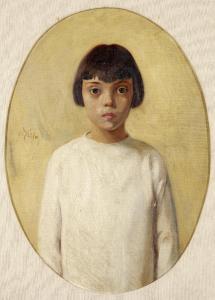
Nikolaos Lytras (Greek, 1883-1927)
Portrait of a lady
signed in Greek (upper left)
oil on canvas
70.5 x 55 cm.
EXHIBITED: Athens, National Gallery and Alexander Soutzos Museum, Nikos Lytras Retrospective , 19 March - 2 June 2008. LITERATURE: A. Kouria - D. Portolos, Nikos Lytras , National Gallery & ELIA Edition, Athens 2008, p. 65, no 23 (illustrated).
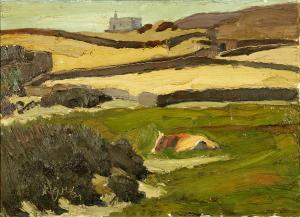
Nicholaos Lytras - Landscape
Original
Auction:
Bonhams -May 17, 2011
- London
Lot number:
28
Other WORKS AT AUCTION
Description:
Nikolaos Lytras (Greek, 1883-1927)
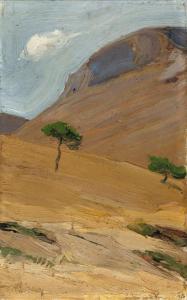
Landscape
signed in Greek (lower right)
oil on canvas
54 x 42.5 cm.
PROVENANCE: Private collection, Athens. A work full of vitality and inner strength that can deservedlystand next to the great masterpieces of early European modernism,this captivating picture encapsulates all the signature traits ofLytras' landscape painting. Painterly, Cezannesque technique,intense brushwork in the vein of van Gogh and thick impasto thatlends a corporeal presence to the pictorial space support theliberation of properties intrinsic to the artist's medium,asserting the freedom of his pictorial gesture. The fluid rhythm ofthe execution becomes the means by which the artist not onlyrecords but shares in this field of energy in search of a deeperpictorial truth. The simplified surfaces with their syncopatedrhythm, the corporeality of the picture plane and the gestural,textured brushwork that convey to the viewer a sense of immediacyand an impression of a first-hand experience, act jointly toachieve the final expressive outcome, capturing the eternalstructure and timeless canon of the Greek landscape. The powerful, pronounced diagonal of the hillslopes, the large,triangular shapes and the overall development of oblique,undulating lines, build up a solid compositional edifice, whichcreates a new reality through an architectural organisation ofactive space and vibrant form without breaking from the world ofappearances. The artist achieves the sense of substance with whichhe endows his forms by the density and texture of the paint itself,while developing a rhythmically articulate series of formalelements that weld the image and its attendant attributes into acompelling entity. Even the artist's signature on the lower rightis treated in a purely formal manner, becoming organicallyintegrated in the pictorial surface, as if it were an 'indigenous'part of the landscape. (Compare Hymettus and Attic Landscape in the Katsigras Museum collection.)
As noted byProfessor C. Christou, "Lytras' landscapes offer a monumental imageof the natural environment and express all its inner forces.Without completely sacrificing the external characteristics of thelandscape, the artist manages to represent it as a comprehensivewhole with perfectly balanced constituent elements: broad surfaces,energetic brushwork, expressive use of colour and structuredorganization."
Landscape was probably painted towards the end of the 1910s,while the rolling background hills suggest a view of an Atticlandscape -a rich source of inspiration for the artist offering himmany pictorial challenges. (Compare From Galatsi sold byBonhams, Greek Sale, 19.5.9009, lot 32.) As noted by A. Kouria andD. Portolos, who prepared the monograph on the artist, "the Atticlandscape persistently claimed Lytras' attention since it wassparse, barren, with pellucid, pure forms and planes in atranslucent atmosphere and with an innate rhythm. Lytras' paintingslend the Greek landscape a new formal identity and meaning, withthe natural environment stripped of the descriptiveness andnarrative of traditional naturalistic renderings, oftencharacterised by a tendency for idealisation, genre overtones andpenchant for the blatantly picturesque. His landscapes are rugged,frugal, without beautifying tricks or decorative framings, oftenrelying instead on a limited and very restrained palette. Moreover,identifying many of these landscapes is problematic, if notimpossible, due to the artist's fragmentary visual approach andabstractive process, as well as the lack of anecdotal elements orlandmarks that shape the superficial features and determine theidentity of a specific area."
In his search for an interpretative approach to nature, Lytras, whoco-founded the legendary anti-academic 'Omas Techni' art group,infused the forces of renewal in Greek painting with a fresh andvital impetus and had a major impact on the artists of the 1930sgeneration who set out not only to identify the unique character ofGreekness but also to interpret its very soul. As noted by AthensNational Gallery director M. Lambraki-Plaka, "Nikolaos Lytras was apainter committed to the truth of vision and a true revolutionarywho reinvigorated Greek painting."
See A. Kouria in The G. I. KatsigrasCollection [in Greek], Municipal Gallery of Larissa -G.I.Katsigras Museum, Larissa 2005, p. 132.
C. Christou, The Mountainous Landscape in GreekPainting [in Greek], To Ergastiri Art Editions, Athens 1991, p.26.
A. Kouria, D. Portolos, Nikos Lytras, BuildingForm with Color and Light [in Greek], exhibition catalogue,National Gallery - A. Soutzos Museum, Athens 2008, pp. 107-109,113.
M. Lambraki-Plaka, introduction to Nikos Lytras,Building Form with Colour and Light , p. 14.
Nicholaos Lytras - Still Life With Fruit
Original
Auction:
Sotheby's -May 9, 2011
- London
Lot number:
58
Other WORKS AT AUCTION
Description:
LOT 58
NIKOLAOS LYTRAS
GREEK, 1883-1927
STILL LIFE WITH FRUIT
indistinctly signed upper right
oil on canvas
8,000—12,000 GBP
49.5 by 34.5cm., 19½ by 13½in.
We are grateful to Aphrodite Kouria for her assistance incataloguing this lot.
Private Collection, Athens
Athens, Zappion, Nikolaos Lytras, 1929
Nicholaos Lytras - The Milk
Original
Auction:
Bonhams -Nov 23, 2010
- London
Lot number:
22
Other WORKS AT AUCTION
Description:
Nikolaos Lytras (Greek, 1883-1927)
The milk
signed in Greek (upper right)
oil on canvas
48.5 x 39 cm.
Painted before 1917. PROVENANCE: Private collection, Athens. EXHIBITED: Athens, Zappeion, Panhellenic Artistic Exhibition of Greek ArtistsAssociation, 1917 (no 427). Athens, National Gallery-Alexandros Soutzos Museum, The Child inGreek Art, 19th-20th Century , 1993 (illustrated in theexhibition catalogue, no. 56, p. 137). LITERATURE: Afroditi Kouria-Dimitris Portolos, Nikos Lytras , NationalGallery and ELIA Edition, Athens 2008, no 60, p. 179(illustrated). Chariklia-Glafki Gotsi, The artist N. Lytras , dissertationthesis, Thessaloniki 1992, pp. 44-45, 100, illustration 62. Afroditi Kouria-Irene Orati, The child in Neohellenic Art ,National Gallery Edition, Athens 1993, no 56. A. Kouria, I. Orati, 'The Child in Art', Kathimerini daily (EptaImeres), 1-2.1.1994, p. 15 (referred). " Milk is one of Nikolaos Lytras' most remarkable works. Thekey expressive means here are the handling of space and the croppedvisual field, which invite the viewer to actively engage in thepicture. The reverse perspective which lends prominence to theforeground, the zoom-like focus on secondary pictorial elements,the enlargement of detail, the clustering of objects at the edges,the arbitrary, snapshot-like cropping and framing, and the symmetryand centrifugal motion, all work together to support therepresentation's dynamic, conveying the immediacy and subjectivityof an impression, of a visual perception that is dynamic ratherthan static or dictated by the hierarchical arrangement of theiconographical elements manifested in academic, naturalistic genrepainting. The closeness and sense of familiarity felt by the viewereliminate the visual and psychological distance from the pictorialevent. The lively tonal and colour juxtapositions of large,simplified surfaces with their syncopated rhythm, as well as thegestural, textured brushwork that amplifies the impression of afirst-hand experience, act jointly to achieve the final expressiveoutcome. This work, like The peeling of quinces betraysinfluences of similar subjects by Bonnard (compare Le cafè, 1914,The Tate Modern, London).
In Lytras' work, however, thehuman figure always maintains its integrity, its head notarbitrarily cropped to become just another motif as the otherformal elements of the picture."
The figure's compositional importance is ensured by a rhythmicalsequence of an arresting cluster of still life elements, whichdirects the eye from the cropped ark shape in the extremeforeground to the china milk cup, to the gleaming tray of highlypolished silver holding a silver teapot, to the matching sugar bowland finally to the cup held by the little girl at the end of thetable. Floating on a sea of cream white hues, this wonderful stilllife offers solidity and weight as well as convex shapes for theartist's exploration of volume and complex treatment of pictorialspace. This skilful spatial organization is complemented by certainmaster touches, such as the wonderful sickle-like reflection on thetray rim matching the two earth colours of the background. Both the figure and the still-life objects are modelled not throughtonal gradations but through close juxtapositions of varied huesevoking tactile roundness. The artist achieves the sense ofsubstance with which he endows his forms by the density and textureof the paint itself, while developing a rhythmically articulateseries of formal elements that weld the image and its attendantattributes into a compelling entity. As noted by H.G. Gotsi, whodid her graduate thesis on Lytras, "the artist is mainly interestedin handling the interaction of the objects on the table, revealinghis great aptitude in using brushwork to generate shapes and forms.This work is distinguished by its intense luminosity and use ofpure colour, applied on canvas with narrow brushstrokes. Outlinesdissolve while the painter sets out to endow his forms with asculptural quality and organize his composition in terms ofgeometric patterns, an approach akin to the formulations ofCezanne."
In 1993, Milk -together with Straw Hat and LittleDonkey , Athens National Gallery's famous jewels - was selectedto represent Lytras' work in the "Child in Greek Art / 19th-20thCentury" exhibition organized by the Greek Ministry of Culture atthe National Gallery in Athens. The painting is discussed in theexhibition catalogue as follows: "The interaction of light andcolour are of great concern to Nikolaos Lytras, even when he isdealing with an interior scene, as shown in this piece of urbangenre that might be portraying one of the artist's daughters basedon anecdotal information provided by a previous owner. Here againLytras comes through as a true master in the handling of colour,which has always been his signature trait. Broad, intensebrushstrokes build up the figure of the girl with the piercinggaze. The bow in her hair seems like a pretext for some livelywhite brushstrokes that highlight the child's face. The sparsegeometry of form provides the underlying framework of thecomposition, which is organised into large areas ofundifferentiated colour by means of intense tonal juxtapositions.Relying on the dynamically pronounced tabletop foreground thatdominates the picture, the overall compositional layout evokes asense of a more immediate and subjective impression, echoingcertain works by Bonnard with similar subjects."
Painterly technique, energetic brushwork, vibrant form and texturedsurface support the liberation of properties intrinsic to theartist's medium, asserting the freedom of his pictorial gesture,while the fluid rhythm of the execution becomes the means by whichthe artist not only records but shares in this field of energy insearch of a deeper pictorial truth. Around the time he painted Milk , Lytras co-founded the legendary 'Omas Techni,' ananti-academic art group, which infused the forces of renewal inGreek painting with a fresh and vital impetus and had a majorimpact on the 1930s generation. As noted by Athens National GalleryDirector M. Lambraki-Plaka, "Nikolaos Lytras was a paintercommitted to the truth of vision, a true revolutionary whoreinvigorated Greek painting and left a rich legacy of works fullof vitality and inner truth that can deservedly stand next to thegreat masterpieces of early European modernism."
In Le cafè , Bonnard's wife Marthe sips coffee,with her pet dog at her side. The table stretches invitingly beforeus, so that the painting appears to record the casual glance ofsomeone about to sit down opposite Marthe. (From the displaycaption, Sept. 2004).
A. Kouria, D. Portolos, Nikos Lytras, BuildingForm with Colour and Light [in Greek], National Gallery-A.Soutzos Museum & Hellenic Literary and Historical Archive,Athens 2008, p. 159.
H.G. Gotsi, The Painter Nikos Lytras 1883-1927 (graduate thesis) [in Greek], Thessaloniki, 1992, pp. 44-45.
A.B.K. in The Child in Greek Art, 19th-20thCentury , exhibition catalogue., National Gallery-AlexandrosSoutzos Museum, Athens 1993, p. 136.
M. Lambraki-Plaka, introduction to Nikos Lytras,Building Form with Colour and Light , p. 14.