Charles Edward Hallé
TweetFollow the artist with our email alert
(1846 - 1919 ) - Artworks

Winter Associates /Apr 21, 2008
€2,830.54 - €4,088.56
Not Sold
Find artworks, auction results, sale prices and pictures of Charles Edward Hallé at auctions worldwide.
Go to the complete price list of works
Along with Charles Edward Hallé, our clients also searched for the following authors:
George Vempley Burwood, Gerald Ackermann, Theresa Sylvester Stannard, Henry Bright, William Callow, John Joseph Cotman, John Duvall
Artworks in Arcadja
19Some works of Charles Edward Hallé
Extracted between 19 works in the catalog of ArcadjaCharles Edward Hallé - Luna
Original
Auction:
Christie's -Dec 15, 2011
- London
Lot number:
18
Other WORKS AT AUCTION
Description:
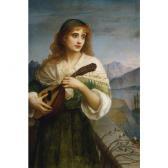
Charles Edward Hallé (1846-1914) Luna signed 'C.E.Hallé' (lower left) oil on canvas 27 x 20 in. (68.5 x 51 cm.)
Anonymous sale; Christie's, London, 25 March 1994, lot 74, where purchased by the present owner.
Hallé was born in Paris, the son of (Sir) Charles Hallé, the pianist and conductor, and came to England at the time of the revolution of 1848. Much of his young adulthood was spent in Italy, but back in London he established himself as a portrait painter while also attempting imaginative and literary themes. In 1877 he and Joseph Comyns Carr assisted Sir Coutts Lindsay in founding the Grosvenor Gallery to show the work of the more advanced artists of the day: the venue immediately became the flagship of the Aesthetic Movement. When, in 1887, disputes arose over the running of the Grosvenor, Hallé and Carr withdrew and, with the support of Burne-Jones and other luminaries, opened the New Gallery in Regent Street the following year. Hallé continued to paint, exhibiting regularly at both the Grosvenor and New Galleries, but he is remembered chiefly for the part he played in these ventures. The present picture has not been identified, nor is it clear whether it is essentially a portrait or an imaginative conception. It is, however, highly characteristic of Hallé, with its echoes of Venetian painting and Burne-Jones and its general mood of 'aestheticism', created not least by the fan, one of the primary motifs (like the peacock feather and the sunflower) of the Aesthetic Movement.
Charles Edward Hallé - Signed Lowerright
Original
Lot number:
61
Other WORKS AT AUCTION
Description:
Lot #61 - 10/13/2008
Charles Edward Halle (British, 1846-1914) oil on canvas, portraitof a young woman in a blue dress sewing a scarf, signed lowerright, 3 1/2" split in canvas lower center with surrounding area ofinpainting, small dent in canvas to left of face, some scatteredsmall spots of paint loss and minor inpainting at edges, in anelaborate period gilt gesso frame with minor loss and smallrepairs, ss. 30" h. x 22" w.
Estimate: $3500 - $5000
Email This Lot to a Friend
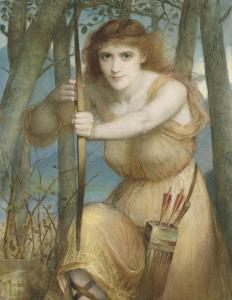
Charles Edward Hallé - The Archer
Original
Auction:
Sotheby's -Jul 15, 2008
- London
Lot number:
28
Other WORKS AT AUCTION
Description:
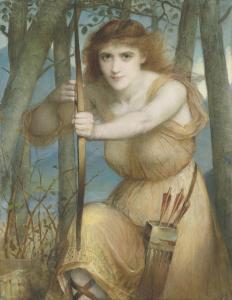
91.5 by 72 cm., 36 by 28 1/2 in.
DESCRIPTION
signed l.l.: C E Hallé
oil on canvas
EXHIBITED
London, New Gallery, 1909, (West Room)
CATALOGUE NOTE
Charles Hallé was the son of the pianist and conductor CarlHallé (later Sir Charles Hallé). He trained as an artist underBaron Marochetti and L. von Mottez and commenced as an exhibitor –principally of portraits – at the Royal Academy in the late1860s.In the autumn of 1875 discussions between Hallé and Sir CouttsLindsay focused on how a new exhibition space could be created inwhich works of art by the advanced circle of painters associatedwith the Aesthetic movement who were then particularly dissatisfiedwith the Royal Academy as a place to display might be shown moresympathetically. In the first place Lindsay offered to pay therental on a temporary exhibition space, but in due course the ideaof a permanent gallery emerged. Hallé was recruited by Lindsay tofind suitable premises, and also to determine which artists mightbe ready to participate. The Grosvenor Gallery, occupying a newlyconstructed building in London's New Bond Street, opened in May1877. Hallé and Joseph Comyns Carr had day-to-day responsibilityfor the running of the Grosvenor, and were invaluable as assistantsto Lindsay because both men were familiar and well-liked figures inthe London art world and therefore in a good position to canvassthe support of painters who might be invited to exhibit. From thestart Hallé exhibited his own works in the Grosvenor summerexhibitions. Walford Graham Robertson remembered him with affectionand admiration: 'Hallé was certainly an artist; he loved art trulyand well and served her faithfully' (Time Was
, London, 1931,p. 46).The Grosvenor allowed the works of a number of progressive artiststo be seen and appreciated, notably those of Edward Burne-Jones,George Frederic Watts and James McNeill Whistler – all painters whohad made up their minds to abstain from the Royal Academy summerexhibitions. However, over the years that followed there were everincreasing difficulties and disagreements among the people involvedin the management of the gallery, exacerbated by the financialproblems that Lindsay faced after the failure of his marriage toBlanche Lindsay. In 1887 Hallé and Carr left the Grosvenor to setup their own gallery, to be called the New Gallery and whichoperated from a space in Lower Regent Street.The New Gallery was even more remarkable as a pioneering exhibitionspace adapted to the sensibilities of the artists themselves and inwhich works might be seen to advantage than the Grosvenor had been.Summer exhibitions of new works by contemporary artists whose Halléand Carr regarded as interesting and worth promoting took place inMay of each year, while in the winter they held exhibitions ofhistorical works and retrospectives and memorial exhibitions. Themost important of these were the displays of works by Burne-Jones,in the winter of 1892-3, and G. F. Watts, in 1896-7. In 1897-8 anexhibition of works by Rossetti (who had always resistedinvitations to see his works included in either the Grosvenor orNew Gallery exhibitions in his lifetime) was held, and in 1898-9, amemorial exhibition of works by Burne-Jones.Hallé's own style of painting – of which The Archer is afine example – represents a hybrid of the aesthetic figurativestyle of Burne-Jones tinged with theatrical classicism of the typeled by Lawrence Alma-Tadema. Although not identified as the subjectof the painting in its title, the work appears to show Diana, thevirgin huntress and goddess of the Moon. Hallé may have had in mindone of the familiar mythological episodes in which Diana is theprotagonist, for example the Death of Actaeon or the punishment ofCallisto. Diana stands as a symbol of womankind's independence frommen, and woman's desire for revenge against abuse suffered at thehands of men. Therefore, the menacing way in which the goddessseems to advance upon the spectator was perhaps a deliberate motifwhich may have seemed apposite at a time shortly before the GreatWar when the militant feminist suffragette movement was mounting instrength.CSN
Charles Edward Hallé - Signed Lowerright
Original
Lot number:
186
Other WORKS AT AUCTION
Description:
Lot #186 - 4/21/2008
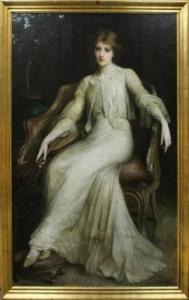
Charles Edward Halle (British, 1846-1914) oil on canvas, portraitof a young woman in a blue dress sewing a scarf, signed lowerright, 3 1/2" split in canvas lower center with surrounding area ofinpainting, small dent in canvas to left of face, some scatteredsmall spots of paint loss and minor inpainting at edges, in anelaborate period gilt gesso frame with minor loss and smallrepairs, ss. 30" h. x 22" w.
Estimate: $4500 - $6500
Email This Lot to a Friend
Charles Edward Hallé - Vates
Original 1889
Auction:
Christie's -Jun 7, 2007
- London
Lot number:
44
Other WORKS AT AUCTION
Description:
Charles
Edward Hallé (1846-1914)
Vates
signed 'C.E. Hallé' (on the step)
oil on canvas
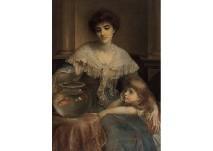
60 x 31 in. (150 x 76.2 cm.)
Literature
Possibly
Henry Blackburn (ed.),
Academy Sketches, London, 1889,
illustrated, p. 114.
Exhibited
Possibly
London, New Gallery, 1889, no. 46.
Lot
Notes
This is
either a version of a larger work, or a fragment of the work
itself. It corresponds to the left-hand side of
Vates, (The
Seer, or Prophet), a picture exhibited by Hallé at the New Gallery
in 1889 with the following couplet in the catalogue:
'Seek not to fathom what is best unknown,
Nor lift with prying hand the veil of Fate'.
The New Gallery picture included a second, older woman on the
right, presumably a seeker of the oracle's advice, while a brazier
is seen in the foreground. The full composition is illustrated in
outline in Henry Blackburn's
Academy Sketches, 1889.
Hallé was born in Paris, the son of Sir Charles Hallé, the
pianist and conductor, and came to England with his parents around
the time of the revolution in 1848. His earliest teachers were
Richard Doyle (a lifelong friend) and Baron Marochetti. He then
entered the Royal Academy schools, and at the age of 16 spent a
year in Paris, studying under Ingres's pupil Victor Mottez. When
his health broke down he went on to travel in Italy, where he seems
to have been particularly responsive to the neo-classical and
Nazarene tradition in Rome. In 1867 he spent a year in Venice, a
city which he claimed 'captivated me, and laid a spell on me which
I have never quite shaken off'. Back in London Hallé met Rossetti
and Burne-Jones, and in 1877 he and Joseph Comyns Carr assisted Sir
Coutts Lindsay in the founding of the Grosvenor Gallery, to show
the work of the more advanced artists of the day. It immediately
became the flagship of the Aesthetic Movement. When disputes arose
over the running of the Grosvenor, Hallé and Carr withdrew and,
with the support of Burne-Jones and other luminaries, opened the
New Gallery in Regent Street in 1888.
Hallé continued to paint, exhibiting regularly at the Grosvenor
and New Galleries, but he is remembered chiefly for the key part he
played in these ventures, with their commitment to innovative art,
their amibitious and wide ranging winter exhibitions, and above all
their revolutionary approach to display.
The composition of the present picture is strongly reminiscent of
Reynolds's
Mrs Siddons as the Tragic Muse, which Hallé
would have seen at the Dulwich Picture Gallery. Reynolds's
composition in turn ultimately derives from the figure of Isaiah by
Michelangelo on the ceiling of the Sistine Chapel, which Hallé
would also have seen on his travels.