Christie's /Apr 6, 2006
€97,465.89 - €146,198.83
€116,956.80
Find artworks, auction results, sale prices and pictures of Giovanni Di Paolo at auctions worldwide.
Go to the complete price list of works
Variants on Artist's name :

Paolo Di Giovanni
Along with Giovanni Di Paolo, our clients also searched for the following authors:
Nannoccio Capassini, Ansano Mancio Di Sano Di Pietro
Artworks in Arcadja
10Some works of Giovanni Di Paolo
Extracted between 10 works in the catalog of ArcadjaGiovanni Di Paolo - The Madonna Of Humility
Original
Auction:
Christie's -Jul 3, 2012
- London
Lot number:
30
Other WORKS AT AUCTION
Description:
Lot Description
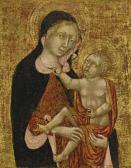
Giovanni di Paolo (Siena c. 1399-1442) The Madonna of Humility on gold ground panel, arched top 31¼ x 21½ in. (79.3 x 54.6 cm.) with the old inscription 'guido Da siena 1221' (on the reverse of the panel)
Provenance
Presumably still in Siena in the early nineteenth century (on the basis of the old inscription on the verso).
Pre-Lot Text
THE PROPERTY OF A EUROPEAN COLLECTOR
View Lot Notes ›
This hitherto unrecorded Madonna of Humility is a characteristic and relatively early work, datable to the 1430s, by the most individual and uncompromising Sienese painter of the mid-fifteenth century.
The theme of the Madonna of Humility, with the Virgin seated on a cushion placed on the ground rather than a throne, was popular in Siena from the mid-trecento, as panels by such artists as Niccolo di Buonaccorso, Francesco di Vannuccio, Andrea di Bartolo and Gregorio di Cecco attest, although it also had a wider currency, as for example the panel by Gentile da Fabriano at Pisa exemplifies. The subject was treated at least nine times by the greatest master of quattrocento Siena, Sassetta, both within the context of full-scale altarpieces and in five panels that must have been intended for private devotion (New York, Metropolitan Museum of Art; Pittsburg, Frick Art and Historical Center; Rome, Pinacoteca Vaticana; Siena, Pinacoteca Nazionale; and Zagreb, Strossmayerova Galerija), all datable to the 1430s and 1440s. Like his contemporary Sano di Pietro, whose panels of the subject include the beautiful example at Montalcino, Giovanni di Paolo was unquestionably aware of Sassetta's closely interrelated compositions. His best-known treatments of the subject, the Madonnas of Humility at Boston and Siena with landscape backgrounds, which like this unpublished picture were clearly supplied for private use, may have depended upon a further, now lost, Madonna of Humility by Sassetta. In this panel, as in that by Sassetta in New York, the Virgin is turned to the right. But Giovanni di Paolo, unlike Sassetta, frames Her head within Her mantle. Giovanni's Child is larger in proportion to His mother than in any of Sassetta's treatments of the theme, is of a more muscular type, and (as is the case in the picture by Sassetta at Siena) turns to look not at the Virgin but outwards to engage the viewer. The wiry dynamism of the Child and the prehensile fingers are wonderfully characteristic of Giovanni di Paolo, as is the rippling rhythm of the hem of the Madonna's mantle.
Giovanni Di Paolo - The Annunciation: The Archangel Gabriel; And The Virgin Annunciate- Pinnacles From An Altarpiece
Original
Auction:
Christie's -Dec 7, 2010
- London
Lot number:
9
Other WORKS AT AUCTION
Description:
Giovanni di Paolo (Siena c. 1399-1482)
The Annunciation: The Archangel Gabriel; and The Virgin Annunciate- pinnacles from an altarpiece
on gold ground panel, shaped tops, in engaged frames
41 7/8 x 16 7/8 in. (106.4 x 42.9 cm.)
two (2)
THE PROPERTY OF A EUROPEAN FAMILY
Sacristy of the Venerabile Compagnia degli Artisti,Montepulciano, 1862 (see Brogi). with Alois Stegmüller. Anonymous sale; Berlinghof, Heidelberg, 21-2 December 1980, lot 76,pls. 170-1, as by an unknown northern painter, circa 1500, whereacquired by the present owners.
F. Brogi, Inventario generale degli oggetti d'arte dellaprovincia di Siena, Siena, 1897, p. 305. J. Pope-Hennessy, Giovanni di Paolo, London, 1937, p. 178. C. Brandi, Giovanni di Paolo, Florence, 1947, pp. 78ff. P. Riedl, 'Eine wiederentdeckte "Verkündigung Mariä" von Giovannidi Paolo', Sitzungsberichte del Heidelberger Akademie derWissenschaften, Philosphisch-historische Klasse, 1986, 2,Heidelberg, 1985. C.B. Strehlke, Painting in Renaissance Siena, 1420-1500, exhibitioncatalogue, New York, 1988, p. 210. A.B. Rave, 'Die Italienische Malerei in der StaatsgalerieStuttgart', Mitteilungen aus der Museumwesen Baden-Württemburg,1992, p. 45. R. Klapproth and G. Ewald, Katalog alte meister, StaatsgalerieStuttgart, Stuttgart, 1990, pp. 148-9, illustrated. A.B. Rave, Frühe Italienische Tafelmalerei, Stuttgart, 1999, pp.105-7, illustrated.
Stuttgart, Staatsgalerie, on loan.
The correct attribution of these characteristically sinuouspinnacles to the most individual and eccentric of mid-quattrocentoSienese masters was due to Pieter Riedl, who realised that theymust correspond with the two panels of matching measurements (106by 42 cm.) recorded in the sacristy of the Compagnia degli Artistiat Montepulciano in 1862 (see above). Riedl suggested that thepinnacles may have belonged to a major altarpiece of 1453, of whichthe main panels, Saint Nicholas enthroned with Saints Bernardino,Francis, Clare and Louis of Toulouse, with roundels of Saints Pauland Jerome are in the Pinacoteca Nazionale, Siena (no. 173),hypothesising that this evidently Franciscan commission might havebeen intended for the church of Saint Francesco at Montepulciano.Riedl considered that the scale of the figures, and their style, aswell as the elaborate ornamentation of the gold in these panels iscompatible with that of the altarpiece now in Siena. The Siena altarpiece is, however, iconographically incompatiblewith the three predella panels also recorded by Brogi in theCompagnia degli Artisti at Montepulciano in 1862, the Baptism(Oxford, Ashmolean Museum), the Crucifixion (private collection),and The attempted Martyrdom of Saint John the Evangelist at thePorta Latina (Florence, Dr. Lino Pasquali). A further panel, notseen by Brogi, was associated with these by Sir John Pope-Hennessy,the Saint John the Evangelist raising Drusiana (New York, theMetropolitan Museum of Art, Lehman Collection). Carl Strehlke notedthat the main register is likely to have shown the Madonna andChild between Saints John the Baptist and John the Evangelist andat least two other lateral Saints. He notes that the Chapel of theCompagnia degli Artisti took the site of the former Silvestrinechurch of San Giovanni del Poggiolo, for which Giovanni di Paolo'spolyptych would have been an appropriate high altarpiece. TheCompagnia degli Artisti altarpiece is likely to have been closelycontemporary with the Saint Nicholas of Tolentino altarpiece,signed and dated 1456, now in the church of Sant' Agostino atMontepulciano; this was presumably painted for that church, or forthat of Santa Mustiola, also an Augustinian foundation. Strehlkefairly considers that stylistically the predella panels fit withpictures of the period encompassed by the 1456 panel and works ofthe early 1460s. Intended to be seen from below, so that the forms literally floaton the gold grounds, these pinnacles demonstrate Giovanni diPaolo's unremitting attention to the preparation of his engravedgrounds. Such details as the head of the angel, in which the artistretracts the lower line of the chin from the outline established inthe ground, demonstrate his ability to refine his visual ideas andexpress the tremulous conviction that underlay a visionary artisticpersonality that was sublimely impervious to alien influence, butexpresses a very Sienese fluidity of both form and line, inheritedfrom the world of Simone Martini and his early trecentocontemporaries, but filtered through the art of Jacopo dellaQuercia as well as the artist's older contemporarySassetta.
Giovanni Di Paolo - The Annunciation: The Archangel Gabriel; And The Virgin Annunciate: Pinnacles From An Altarpiece
Original
Auction:
Christie's -Dec 8, 2009
- London
Lot number:
41
Other WORKS AT AUCTION
Description:
Giovanni di Paolo (Siena c. 1399-1482)
The Annunciation: The Archangel Gabriel; and The Virgin Annunciate: pinnacles from an altarpiece
on gold ground panel, shaped tops, in engaged frames
41 7/8 x 16 7/8 in. (106.4 x 42.9 cm.)
two (2)
Pre-Lot Text
THE PROPERTY OF A EUROPEAN FAMILY
Provenance
Sacristy of the Venerabile Compagnia degli Artisti, Montepulciano, 1862 (see Brogi).
with Alois Stegmüller.
Anonymous sale; Berlinghof, Heidelberg, 21-2 December 1980, lot 76, pls. 170-1, as by an unknown northern painter, circa 1500, where acquired by the present owners.
Literature
F. Brogi, Inventario generale degli oggetti d'arte della provincia di Siena, Siena, 1897, p. 305.
J. Pope-Hennessy, Giovanni di Paolo, London, 1937, p. 178.
C. Brandi, Giovanni di Paolo, Florence, 1947, pp. 78 ff.
P. Riedl, 'Eine wiederentdeckte "Verkündigung Mariä" von Giovanni di Paolo', Sitzungsberichte del Heidelberger Akademie der Wissenschaften, Philosphisch-historische Klasse, 1986, 2, Heidelberg, 1985.
C.B. Strehlke, in the exhibition catalogue, Painting in Renaissance Siena 1420-1500, New York, 1988, p. 210.
A.B. Rave, 'Die Italienische Malerei in der Staatsgalerie Stuttgart, Mitteilungen aus der Museumwesen Baden-Württemburg, 1992, p. 45.
R. Klapproth and G. Ewald, Katalog alte meister, Staatsgalerie Stuttgart, Stuttgart, 1990, pp. 148-9, illustrated.
A.B. Rave, Frühe Italienische Tafelmalerei, Stuttgart, 1999, pp. 105-7, illustrated.
Exhibited
Stuttgart, Staatsgalerie, on loan.
Lot Notes
The correct attribution of these characteristically sinuous pinnacles to the most individual and eccentric of mid-quattrocento Sienese masters was due to Pieter Riedl, who realised that they must correspond with the two panels of matching measurements (106 by 42 cm.) recorded in the sacristy of the Compagnia degli Artisti at Montepulciano in 1862 (see above). Riedl suggested that the pinnacles may have belonged to a major altarpiece of 1453, of which the main panels, Saint Nicholas enthroned with Saints Bernardino, Francis, Clare and Louis of Toulouse, with roundels of Saints Paul and Jerome, are in the Pinacoteca Nazionale, Siena (no. 173), hypothesising that this evidently Franciscan commission might have been intended for the church of Saint Francesco at Montepulciano. Riedl considered that the scale of the figures, and their style, as well as the elaborate ornamentation of the gold in these panels is compatible with that of the altarpiece now in Siena.
The Siena altarpiece is, however, iconographically incompatible with the three predella panels also recorded by Brogi in the Compagnia degli Artisti at Montepulciano in 1862, the Baptism (Oxford, Ashmolean Museum), the Crucifixion (private collection), and The attempted Martyrdom of Saint John the Evangelist at the Porta Latina (Florence, Dr. Lino Pasquali). A further panel, not seen by Brogi, was associated with these by Sir John Pope-Hennessy, the Saint John the Evangelist raising Drusiana (New York, the Metropolitan Museum of Art, Lehman Collection). Carl Strehlke noted that the main register is likely to have shown the Madonna and Child between Saints John the Baptist and John the Evangelist and at least two other lateral saints. He notes that the Chapel of the Compagnia degli Artisti took the site of the former Silvestrine church of San Giovanni del Poggiolo, for which Giovanni di Paolo's polyptych would have been an appropriate high altarpiece. The Compagnia degli Artisti altarpiece is likely to have been closely contemporary with the Saint Nicholas of Tolentino altarpiece, signed and dated 1456, now in the church of Sant' Agostino at Montepulciano; this was presumably painted for that church, or for that of Santa Mustiola, also an Augustinian foundation. Strehlke fairly considers that stylistically the predella panels fit with pictures of the period encompassed by the 1456 panel and works of the early 1460s.
Intended to be seen from below, so that the forms literally float on the gold grounds, these pinnacles demonstrate Giovanni di Paolo's unremitting attention to the preparation of his engraved grounds. Such details as the head of the angel, in which the artist retracts the lower line of the chin from the outline established in the ground, demonstrate his ability to refine his visual ideas and express the tremulous conviction that underlay a visionary artistic personality that was sublimely impervious to alien influence, but expresses a very Sienese fluidity of both form and line, inherited from the world of Simone Martini and his early trecento contemporaries, but filtered through the art of Jacopo della Quercia as well as the artist's older contemporary Sassetta.
Giovanni Di Paolo - The Nativity
Original 1420
Auction:
Christie's -Apr 6, 2006
- New York
Lot number:
33
Other WORKS AT AUCTION
Description:
Lorenzo di Pietro di Giovanni, Vecchietta (Siena 1410-1480)
The Nativity
tempera and gold on panel
10 x 7¼ in. (25.4 x 18.4 cm.)
Provenance
T.S. Bathurst, London.
with Arhold, Inc., Monte-Carlo, where purchased by the late owner in 1990.
Literature
K. Christiansen, et. al., Painting in Renaissance Siena 1420-1500, New York, 1988, pp. 259-60, no. 43, illustrated.
Exhibited
New York, The Metropolitan Museum of Art, Painting in Renaissance Siena 1420-1500, 20 December 1988 - 19 March 1989, no. 43.
Lot Notes
This charming and exquisitely detailed Nativity reflects, in its iconography, the lasting impact of the mystical revelations of St. Bridget of Sweden and was composed between 1360 and 1370. The kneeling Virgin adores the Christ Child, divine light emanating from his naked body, while the whole scene is observed by the Heavenly Host and God the Father. From above, the dove of the Holy Spirit descends in a ray of light towards the infant. The kneeling shepherd and Saint Joseph at rest (not here holding a candle) derive from more conventional representations of the Nativity. Copies of the writings of Saint Bridget were known to have been in libraries in fifteenth century Siena - among them those of the Compagnia dei Disciplinati, San Francesco, Niccolo Borghesi and Giorgio Tolomeo.
Carl Strehlke (in, K. Christiansen, ed. op. cit. above) has suggested that this beautiful panel, which combines both naturalistic detail and a formal grace in composition, might have been commissioned by 'a member of the Compagnia dei Disciplinati with a special veneration for St. Bridget or a patron like Urbano di Pietro del Bello, rector of the hospital between 1445 and 1450 who commissioned the sacristy frescoes'. Its vertical shape and the large unpainted part originally covered by an engaged frame precludes the possibility that this once formed part of a predella and supports Strehlke's thesis that the original function of this panel was as an object of private devotion.
Il Vecchietta - his nickname 'little old one' has so far not been explained - was almost certainly a pupil of Sassetta. However, although enrolled in the Siena painters' guild in 1428, he does not seem to have been active in Siena until 1439 and worked instead for much of his early career as an assistant to Masolino in Rome and then at Castiglione Olona near Milan where he painted a cycle of frescoes for Cardinal Castiglione Branda. These frescoes include a view of the Santo in Padua and it is likely that Vecchietta's personal interest in highly refined and complicated architectural settings - an interest he would pass on to Francesco di Giorgio - was inspired by the archeologically oriented humanism that flourished at that time in Northern Italy, particularly in Padua. Returning to Siena, Vecchietta was entrusted with another ambitious fresco program, this time the decoration of the Pilgrim's Hospice, which he executed during the 1440s. He would go on to enjoy the support of such enlightened patrons as Aeneas Piccolomini (Pope Pius II) and Niccolo Martinozzi but increasingly turned his attentions to sculpture. Like a number of Sienese painters, notably Neroccio de' Landi and Beccafumi, Vecchietta was extremely versatile, succeeding as a sculptor as well as a painter. His extant sculptures, all bronzes, include the famous Resurrection (Frick Collection, New York) and the Risen Christ (S. Maria della Scala, Siena) which is said to have influenced Michelangelo's marble of the same subject in S. Maria Sopra Minerva, Rome.
This devotional panel can be dated to the most fertile years of Vecchietta's production as a painter, the 1440s, and may be compared to a fresco of the same subject (fig. 1 - although, curiously, it incorporates an Annunciation) painted for the sacristy of Vecchietta's parish church where he was buried, S. Maria della Scala, between 1446 and 1449. The frontal arrangement of the scene, the angels hovering over the roof of the barn, the pose of St. Joseph, even the animals (though their positions are reversed in the fresco) are all so unmistakably similar as to argue for a similar date for the panel.
Giovanni Di Paolo - The Death Of Saint Catherine Of Siena
Original
Auction:
Sotheby's -Jan 24, 2002
- New York
Lot number:
142
Other WORKS AT AUCTION
Description:
tempera and gold on marouflaged
panel
This small panel originally formed
part of a series of panels, possibly intended as a
predella,
illustrating episodes from the life of Saint Catherine: others from
the same series include
Saint Catherine invested with the
Dominican Habit (Cleveland Museum of Art);
The Mystic
Marriage of Saint Catherine (private collection, New York);
Saint Catherine with a Beggar (Cleveland Museum of Art);
Saint Catherine Exchanging her heart with Christ (private
collection, New York);
Saint Catherine Receiving the
Stigmata;
Saint Catherine beseeching Christ to resuscitate
her Mother (both in the Robert Lehman collection, Metropolitan
Museum of Art, New York);
The Miraculous Communion of Saint
Catherine (Metropolitan Museum of Art, New York);
Saint
Catherine Dictating her dialogues to Raymond of Capua (Detroit
Institute of Art);
Saint Catherine before a Pope (Thyssen-Bornemisza Foundation, Madrid); and
The Crucifixion (Rijksmuseum, Amsterdam) (see C. Strehlke, see Literature below,
pp. 224-240, cat. nos. 38 a-k). Two further panels from the
altarpiece, showing
The Blessed Andrea Gallerani and
The
Blessed Ambrogio Sansedoni are in the Robert Lehman collection,
Metropolitan Museum of Art, New York (Strehlke,
op. cit.,
pp. 241-2, cat. nos. 38 l-m). The main panel, showing
The
Purification of the Virgin, is today in the Pinacoteca in
Siena. The so-called ````Saint Catherine of Siena Series' has been
discussed in exhaustive detail by Carl Strehlke (see Literature
below, pp. 218-242), and only some of the points raised by him are
discussed here below.
The altarpiece was apparently commissioned by the guild of the
Pizzicaiuoli (purveyors of dry goods) for their new chapel in the
Spedale di Santa Maria della Scala in 1447, the contract stating
that the altarpiece was to be completed in time for All Saints' Day
(November 1st) in 1449. The contract (cited by Strehlke,
op.
cit., p. 218) does not specify the subject but it does make
clear that the altarpiece was to contain
figuris et storiis (i.e. full-length figures as well as narrative scenes; the latter
presumably referring to a
predella series). There are three
main schools of thought regarding the painting's reconstruction,
which remains entirely conjectural: the first is that the narrative
series was intended from inception to serve as a
predella to
The Purification of the Virgin since the moment of its
inception (a fact supported by the reading of the contract
mentioned above); the second is that the series was added as a sort
of
predella only after Catherine's canonization in 1461 (a
theory possibly supported by the fact that she is shown with a
saint's halo rather than rays, as she had traditionally been
depicted before in Sienese painting); and the third rejects any
association of the smaller scenes with
The Purification of the
Virgin panel and suggests instead that these scenes originally
surrounded an image of Saint Catherine. Although the ````Saint
Catherine Series', to which this panel belongs, could have formed a
predella to the Pizzicaiuoli altarpiece, it is not possible
to suggest an entirely convincing reconstruction without putting
into question the chronology of the scenes or their technical
evidence (for example, the direction of the woodgrain). For an
extremely detailed discussion of the possible arrangement of the
panels, see Strehlke,
ibid., pp. 219-222. The location of
this particular scene within the whole scheme has been tentatively
put forward as a position beneath the front face of the right
pilaster (
idem, p. 220).
The painting's provenance is reconstructed in great detail by
Strehlke (
ibid, p. 218 ff.) who notes that the rectors of
the guild were apparently dissatisfied with the altarpiece and
although they asked for it to be replaced by a Saint Michael the
Archangel (to whom the chapel was dedicated in 1457), the main
panel of the St. Catherine altarpiece was retained
in situ until at least 1575, when it was described by Bossio. Some time in
the mid-17th century, possibly as early as 1639, the altarpiece was
moved from the church to the altar of Santa Cristina in the (no
longer used) cemetery and in the 18th century the painting is
described in great analytical detial by Abate Carli (see Literature
below). By
circa 1775, the date of Carli's manuscript, the
painting had suffered somewhat and had already been dismembered
into smaller fragments: the small paintings (presumably the
predella scenes) were placed in the rectors' rooms. At that
date the painting had already been restored (
rinfrescato)
and Carli describes how the gilding had already begun to wear off
(
The background is gilt, but only in a few places ). On this particular panel, a strip approximately 3 inches wide,
at the extreme right of the composition, is a modern addition,
supposedly filling in for a section of the panel which was
presumably lost or damaged when the
predella panels were
separated and dispersed in the second half of the 18th century. The
monk standing at the right, with raised hands, is a literal
quotation from Giotto's
Death of Saint Francis and the
Verification of the Stigmata in the Bardi Chapel, church of
Santa Croce, Florence, and may be a modern restorer's invention,
though it may equally reflect Giovanni di Paolo's original
composition.
This painting was acquired in Siena by Johann Anton Ramboux,
together with other (though not all) panels from the dismembered
altarpiece, probably in 1838; the year in which Ramboux wrote to
Johann David Passavant, telling him that he had acquired numerous
paintings in Siena which he was sending back to Germany (another
painting acquired on that particular occasion was the Girolamo di
Benvenuto
Presentation of the Virgin panel, also from a
predella, sold, Sotheby's, London, July 9, 1998, lot 60).
Johann Anton Ramboux was an important figure in the history of
collecting. He was an early connoisseur of Italian primitives,
which he collected prolifically in Siena and Florence, principally
between 1838 and 1842. Many of his letters to the authorities in
Florence, and the export documents for his purchases from the
Grand-Duchy of Tuscany are preserved. These, and Ramboux's
activities in Tuscany are amply discussed by Christopher
Merzenich,
Di dilettanza per un' artista - Der Sammler Antonio Giovanni
Ramboux in der Toskana, in
Lust und Verlust. Kölner Sammler
zwischen Trikolore und Preussenadler, exhibition catalogue,
Cologne, Wallraf-Richartz Museum, October 26, 1995-January 28,
1996, pp. 303-321. The painting was also owned by the Belgian
engineer and banker, Adolphe Stoclet (1871-1949), one of the
greatest collectors of Italian primitives in the 20th century. He
began collecting Italian art whilst working on an engineering
project in Milan (for the North Milan Tram Service), between 1896
to 1902, after which he and his wife, Suzanne Stevens, moved to
Vienna to work in a bank for two years, and then to Brussels (after
he had inherited his father's fortune in 1904). He probably
acquired this painting after his return to Belgium and almost
certainly after the completion of his villa, the Palais Stoclet, in
which much of his collection is still housed.
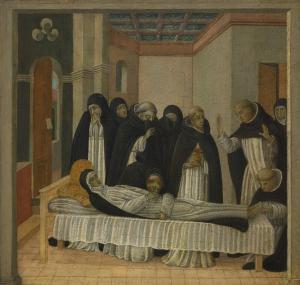
Saint Catherine of Siena died at the age of thirty-three in Rome,
on April 29, 1380. Although she was apparently prepared for her
death, having received indulgences from both Pope Gregory XI and
Pope Urban VI, sources relate that at the time of her death only a
few members of her close family and followers were present.
Giovanni di Paolo has been loyal to the sources in this respect:
only nine people are shown at her bedside, all dressed in Dominican
habits, and they are shown with varying expressions of grief. One
monk kneels to kiss the corpse's crossed hands; another clutches
his habit to his face to wipe the tears; and another buries his
face in his habit with grief. This and other
predella panels
in the ````Saint Catherine of Siena Series' are fine examples of the
type of painting in which Giovanni di Paolo excelled. His powers of
invention in storytelling were perfectly suited to narrative cycles
and this not only engaged his own imagination but also those of his
patrons. Although there was almost no tradition of narrative
painting in Siena prior to the Quattrocento, Giovanni di Paolo -
like many Sienese painters of his generation (including Sano di
Pietro) - applied his skills not just to panel-painting but also to
manuscript illumination (see, for example, those exhibited in
Painting in Renaissance Siena 1420-1500, New York,
Metropolitan Museum of Art, 1988, pp. 178-189).
Provenance: Commissioned from the artist as part of an altarpiece for the
Church of the Spedale of Santa Maria della Scala, Siena, in
1447
acquired by Johann Anton Ramboux, Cologne, probably in 1838 in
Siena (Sale: Heberle/Lempertz, Cologne, May 23, 1867, lot
113)
Fürstlich Hohenzollern'schen Museum, Sigmaringen,
circa 1871
Adolphe Stoclet (1871-1949) collection, Brussels, by 1922 (and
probably after 1904)
John Russell Vanderlip, Minneapolis,
circa 1930
by whom bequeathed to the Minneapolis Institute of Arts, 1935
by whom de-accessioned in 1958
with E.V. Thaw & Co., Inc., New York
from whom acquired by the present collector in 1985
Exhibited: New York, Metropolitan Museum of Art,
Painting in Renaissance
Siena, 1420-1500, December 20, 1988-1989, no. 38j
Boston, Museum of Fine Arts,
Prized Possessions: European
Paintings from Private Collections of Friends of the Museum of Fine
Arts, Boston, June 17-August 16, 1992, no. 59.
Literature: Abate G.G. Carli,
Notizie di Belle Arti (Siena, Biblioteca
Comunale, ms.,
circa 1775), cod. vii-20, f. 86v (transcribed
by C. Brandi, ````````Giovanni di Paolo'',
Le Arti, vol. III,
no. 5, 1941, pp. 320-321)
J.A. Ramboux,
Katalog der Gemälde alter italienischer Meister
(1221-1640) in der Sammlung des Conservator J.A. Ramboux, 1862,
no. 121
Primitifs italiens de la Renaissance, exhibition catalogue,
Brussels, Musées Royaux des Beaux-Arts, 1921
B. Berenson,
Italian Pictures of the Renaissance, 1932, p.
245
C. Brandi,
La Regia Pinacoteca di Siena, 1933, p. 96
B. Berenson,
Pitture Italiane del Rinascimento, 1936, p.
211
J. Pope-Hennessy,
Giovanni di Paolo, 1937, pp. 130-133
J. Pope-Hennessy,
Sienese Quattrocento Painting, 1947, pp.
138-9, 196
C. Brandi,
Quattrocento senesi, 1949, pp. 98-100,
201-7
G.M. Coor,
Quattrocento-Gemälde aus der Sammlung Ramboux
,
Wallraf-Richartz Jahrbuch, vol. XXI, 1959, pp. 82-85
E.O. de Fernandez-Gimenez,
Giovanni di Paolo: The Life of St. Catherine of Siena
,
The Cleveland Museum of Art Bulletin, vol. LIV, 1967, pp.
103-111
B. Berenson,
Italian Pictures of the Renaissance. Central
Italian and North Italian Schools, 1968, vol. I, p. 178 (as
datable to 1447-49)
H.J. Ziemke,
Ramboux und die sienesische Kunst
,
Städel-Jahrbuch, n.s. 2, 1969, pp. 287-8, footnote 8
H.W. van Os,
Giovanni di Paolo's Pizzicaiuolo Altarpiece
,
The Art Bulletin, vol. LIII, 1971, pp. 289-302
H.B.J. Maginnis, Letter,
The Art Bulletin, vol. LVII, 1975,
pp. 608-9 (who erroneously suggested this was a copy after the lost
original; a judgement made upon the basis of photographs pre- and
post-restoration)
F. Zeri & E.E. Gardner,
Italian Paintings: A Catalogue of
the Collection of the Metropolitan Museum of Art: Sienese and
Central Italian Schools, 1980, pp. 24-27
D. Gallavotti Cavallero,
Lo Spedale di Santa Maria della Scala
in Siena: Vicenda di una committenza artistica, 1985, p.
192
J. Pope-Hennessy & L. Kanter,
Italian Paintings in the
Robert Lehman Collection, 1987, pp. 130-131
C.B. Strehlke,
Painting in Renaissance Siena, 1420-1500,
exhibition catalogue, New York, Metropolitan Museum of Art,
December, 1988-1989, pp. 218-224, 238-240, cat. no. 38j, illus.
(prior to restoration) p. 238 and (after restoration) p. 239
M. Boskovits & S. Padovani,
Early Italian Painting
1290-1470: The Thyssen Bornemisza Collection, 1990, p. 17,
104-113
A. Noone,
Prized Possessions: European Paintings from Private
Collections of Friends of the Museum of Fine Arts, Boston,
exhibition catalogue, Boston, Museum of Fine Arts, June 17-August
16, 1992, pp. 158-9, cat. no.59, illus. in color p. 16, pl. 1