Swann Galleries /Oct 27, 2010
€496.84 - €709.77
€1,217.16
Find artworks, auction results, sale prices and pictures of Marian Fortuny at auctions worldwide.
Go to the complete price list of works
Variants on Artist's name :

Fortuny Y Marsal Mariano

Fortuny Y Carbo Mariano

Mariano Jose Maria Bernardo Fortuny Y Carbo

Along with Marian Fortuny, our clients also searched for the following authors:
Haatje Pieters Oosterhuys, Wilhelm Brucke, Benjamin I Vautier, Alfred Rethel, Eugen Gustav Ducker, Johann Friedrich Bolt, Maximilien Albert Hauschild
Artworks in Arcadja
185Some works of Marian Fortuny
Extracted between 185 works in the catalog of ArcadjaMarian Fortuny - Street Scene
Original 1860
Lot number:
436
Other WORKS AT AUCTION
Description:
Description:
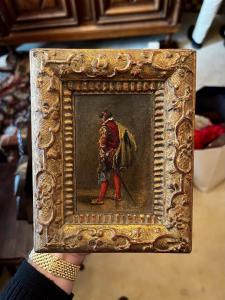
Mariano Jose Mar¡a Bernardo Fortuny y Carbo (Spanish,
1838-1874) "Street Scene," c. 1860,
oil on canvas,
9.5" x 6.5",
signed lower left,
framed
Estimated Value:
$8,000 - $10,000
Absentee Bid
Telephone Bid
Condition Report:
no retouch visible; not examined out of frame; localized areas of cracking to paint; light wear at edges
Marian Fortuny - Arab Fantasia
Original 1866
Auction:
Christie's -Nov 21, 2011
- London
Lot number:
69
Other WORKS AT AUCTION
Description:
Lot Description
Mariano Fortuny Marsal (Spanish, 1838-1874) Arab Fantasia signed, inscribed and dated 'Fortuny/Roma 1866' (lower right) oil on canvas 20 x 24½ in. (50.8 x 62.2 cm.)
Provenance
Walther Fol, Rome (acquired directly from the artist). William H. Vanderbilt, New York. His sale, Parke-Bernet Galleries, New York, 18 April 1945, lot 43. Acquired at the above sale by Flora Whitney Miller, New York. Her sale, Sotheby's, New York, 21 May 1987, lot 75. Anonymous sale; Sotheby's, London, 22 June 2000, lot 13. Acquired at the above sale by the present owner.
Pre-Lot Text
PROPERTY FROM AN IMPORTANT EUROPEAN COLLECTION
Literature
C. Yriarte, 'Fortuny' in L'Art. Revue hebdomadaire illustrée, Paris, 1875, p. 366. W. Fol, 'Fortuny' in Gazette des Beaux-Arts, Paris, April 1875, p. 275. E. Shinn (ed. E. Strahan), The Art Treasures of America, Philadelphia, 1879-1882, vol. III, pp. 98-99, 102, 108 (illustrated). The Private Collection of W.H. Vanderbilt, New York, 1879, p. 14, no. 34; W.H. Vanderbilt's Collection of Paintings, New York, 1884, no. 36. C. Gonzáles and M. Martí, Mariano Fortuny Marsal: Maestros del arte de los siglos XIX y XX, Barcelona, 1989, vol. I, pp. 234-235, pls. 82 and 82bis (illustrated); and vol. II, p. 42, no. OR-0.01.66
Exhibited
New York, Metropolitan Museum of Art, 1886-1903 (on loan from W.H. Vanderbilt). Barcelona, Centre Cultural de la Caixa de Pensions, Fortuny, 18 January - 12 March 1989, no. 17 (this exhibition subsequently travelled to Madrid, Sala d'Exposiciones de la Fundación La Caixa, and to Reus, Museu Comarcal). Barcelona, Museu Nacional d'Art de Catalunya, Barcelona, Fortuny, 17 October 2003 - 18 January 2004, no. 35.
View Lot Notes ›
Fortuny was one of the most diverse, and commercially successful artists of his day. Promoted heavily by the French dealer Goupil, Fortuny became famed for his genre subjects, which were characterised by lightness of touch, and were loosely inspired by the work of artists such as Watteau, and the bright palette of Venetian artists such as Tiepolo. He was also prized as a history and Orientalist painter, who brought the past and near East to life with a strong sense of reality and of colour that was informed by travel throughout Europe and North Africa.
This painting is one of the artist's most important Orientalist compositions, and was acquired directly from Fortuny by his friend, the Swiss collector Walther Fol. A second version, now in the Walters Art Gallery, Baltimore, was painted for Goupil, and was acquired by the American collector William Stewart (fig. 1). The differences between the two canvases lie primarily in the replacement of a bull's head for that of a lion in the second version, and in minor adjustments to the figures in the foreground.
The present scene describes a subject popular with Orientalist painters, a group of warriors dancing frenetically to the sound of their own gunfire, and conflates into a single composition disparate elements that Fortuny had witnessed on a trip to Tangiers in 1862; these include fruit sellers, a Jewish merchant (holding a vase in the left corner), sheikhs and the dancers themselves, which were superimposed onto an architectural background which was, according to Yriarte (op. cit.) observed directly from life. The practice of assembling different motifs was common among most Orientalist painters, who aimed to bring their canvases to life with a sense of almost cinematographic drama, by filling them with exotic, ethnographic details.
Fortuny's vibrant sense of colour and movement, and powerful sense of composition, which are all so distilled into this canvas, were most completely awoken after the artist's first trip to Morocco in 1860, replacing the more linear style of his early years. He responded immediately to the strong light and exotic environment, producing dazzling canvases which convey a strong sense of local colour, and are reminiscent of the turbulent Orientalist canvases of Eugène Delacroix. The present canvas exhibits all these tendencies, with a particularly strong emphasis on shading, colour and movement. The contrast between the frieze-like figures, painted largely in different shades of white, and the swirling, colourful dancers in the foreground, is also particularly effective.
Marian Fortuny - Arabe Delante De Un Tapiz
Original 1873/74
Auction:
Sotheby's -May 18, 2011
- London
Lot number:
109
Other WORKS AT AUCTION
Description:
LOT 109
PROPERTY FROM A SOUTH AMERICAN PRIVATE COLLECTION
- MARIANO FORTUNY
SPANISH, 1838-1874
ARABE DELANTE DE UN TAPIZ (ARAB BEFORE A TAPESTRY)
signed and inscribed Fortuny / Roma lower right
oil on canvas
150,000—250,000 GBP
measurements
150 by 75cm., 59 by 29½in.
Description
signed and inscribed Fortuny / Roma lower right
oil on canvas
PROVENANCE
McLean, London, 1874Mariano de Murrieta, London (acquired from the above. Murrieta,Marquess of Santurce, a banker of Spanish origin living in London,assembled a large and diverse collection of pictures and works ofart which he housed in a purpose built gallery. His collectionincluded paintings by Zamacois, Léon y Escosura, Tusquets, Tapiróand Mas y Fondevila, but the painter that he supported most wasFortuny. The sale of Murietta's collection in 1892 includednineteen works by the artist).
LITERATURE AND REFERENCES
Ricardo de Madrazo, Recuerdos de mi vida, unpublished(prior to 1874), dossier A, p. 3, mentionedCyclopedia of Painters and Paintings, New York, 1887, no. 16Joaquín Ciervo, El arte y el vivir de Fortuny , Barcelona,1921, no. 78, illustratedMariano Fortuny y Madrazo, Fortuny 1838-1874 , Bologna, 1933,no. 29.Carlos González and Montserrat Martí, Mariano Fortuny Marsal:Maestros del arte de los siglos XIX y XX , Barcelona, 1989, vol.II, p. 47, no. OR-0.01.73, illustratedFortuny, MNAC, exh. cat., Barcelona, 2004, p. 46, a detailillustrated; p. 55, discussed & illustrated
CATALOGUE NOTE
Painted in Rome in 1873 at the height of his career, a yearbefore his untimely death at the early age of 36, Fortuny's largeand dramatic canvas Arab before a Tapestry displays the fullflowering of his painterly talents and pays homage to the twocultures closest to his heart: his native Spain and the mystery andexoticism of North Africa.Although he spent most of his working life in Rome, Fortuny wasattracted to the near-Orient at an early age when he travelled toTetuan as a war artist during the Spanish-Moroccan war of 1859-60.He returned on two subsequent occasions when he was especiallyattracted to Tangiers, popularly referred to at the time as 'LittleConstantinople'. On his travels he made copious notes, sketched andpainted and also collected mementos and artefacts with which todecorate his Roman studio and incorporate into hiscompositions.In contrast, he rediscovered the wonders of his native Spain at theend of his life when he travelled to the south of the country andvisited Granada and the Moorish Palace of the Alhambra for thefirst time in 1870. Above all it was the light there that he foundso compelling, adding a new found richness to his palette and arenewed sense of ambition to his compositions.Fortuny's stage management of the marriage of Moorish and Westerncultures in Arab before a Tapestry is carefully arranged foroptimum theatrical effect. The richly patterned vertical drop ofthe Persian Safavid carpet forms a magnificent background to thestanding Arab swaithed in a white robe, who holds a Moroccan muskethorizontally above his chest. To one side of him Fortuny has placeda Spanish twelfth century ivory inlaid casket; to the other amagnificent example of sixteenth century round Hispano-Moresquelustreware. Above the man a hanging Mosque glass issuspended.A photograph of Fortuny dressed in Arab costume holding a gun in asimilar stance to the figure in the present work suggests anelement of self-portraiture in the composition, while the cruciformpose that the Arab holds and the hieratic combination of elementsall around him indicates the veneration of the artist to hissubject.For a preparatory drawing for the present lot see: Goupil et Cie.,Oeuvres de Fortuny reproduites en photographies , Paris,1875, pl. XXXVI
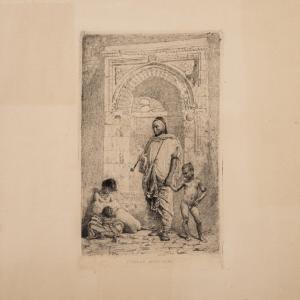
Marian Fortuny - A Moorish Man Standing In An Archway
Original 1866
Lot number:
13
Other WORKS AT AUCTION
Description:
MARIANO FORTUNY Y CARBÓ
A Moorish Man Standing in an Archway
.
Etching and aquatint, circa 1866
.
167x126 mm; 6 5/8x 5inches, full margins
.
Printed by Delâtre, Paris
.
Published by Goupil, Paris
.
An acclaimed Spanish watercolorist and painter, Fortuny (1838-1874)was an artistic prodigy raised by his grandfather inBarcelona
.
Most of his etchings--Orientalist scenes suchas this work--date from the late 1860s/early 1870s when he madeseveral trips to Paris
.
This work, similar in style andcomposition to etchings from Whistler's "French Set," was pulled bythe renowned Parisian printer Auguste Delâtre who also worked withWhistler around this time
.
Estimate $700-1,000
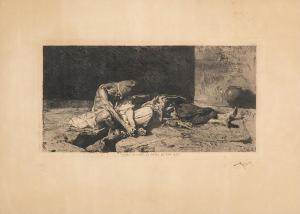
Marian Fortuny - Arabe Veillant Le Corps De 'son Ami
Original
Auction:
Rosebery's -Oct 16, 2008
- London
Lot number:
77
Other WORKS AT AUCTION
Description:
- "Arabe Veillant le Corps de 'Son Ami"; drypointetching with aquatint, on Chine Volant, signed and dated Roma 1866within the plate, bears label for Goupil & Comp, BoulevartMontmartre 19 & Rue Chaptal 19, Paris, attached to the reverse,with one further etching by the same hand, 26x44cm (2)