Frank Cadogan Cowper
TweetFollow the artist with our email alert
United Kingdom (1877 - 1958 ) - Artworks Wikipedia® - Frank Cadogan Cowper

Bonhams /Jun 17, 2009
€4,566.21 - €6,849.31
€4,741.20
Find artworks, auction results, sale prices and pictures of Frank Cadogan Cowper at auctions worldwide.
Go to the complete price list of works
Along with Frank Cadogan Cowper, our clients also searched for the following authors:
Enrico Rossi, Giovanni Malesci, Lorenzo Viani, Giorgio Luxardo, Julian Rossi Ashton, Ritta Boemm, Umberto Boccioni, Alberto Rossi, Louis Mark, Luigi Rossi, Federico Zandomeneghi
Artworks in Arcadja
31Some works of Frank Cadogan Cowper
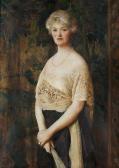
Extracted between 31 works in the catalog of ArcadjaFrank Cadogan Cowper - Portrait Of Elizabeth Witts, Daughter Of Frederick Vavasour Broom Witts (1889-1969)
Original
Auction:
Christie's -Jul 12, 2012
- London
Lot number:
250
Other WORKS AT AUCTION
Description:
Frank Cadogan Cowper, R.A. (1877-1958)
Portrait of Elizabeth Witts, daughter of Frederick Vavasour Broom Witts (1889-1969)
signed, inscribed and dated 'Elizabeth/Daughter of Major-General F.V.B. Witts, C.B.E., D.S.O., M.C./painted 1954 by/F. Cadogan Cowper. R.A.' (on the artist's label attached to the stretcher)
oil on canvas
49½ x 39 3/8 in. (125.7 x 100 cm.)
Frank Cadogan Cowper - Our Lady Of The Fruits Of The Earth
Original 1917
Auction:
Christie's -Dec 15, 2011
- London
Lot number:
23
Other WORKS AT AUCTION
Description:
Frank Cadogan Cowper, R.A. (1877-1958)
Our Lady of the Fruits of the Earth
signed and dated 'F C COWPER/1917' (lower left)
oil on canvas
40 x 29 7/8 in. (102 x 76 cm.)
Anonymous sale; Christie's, London, 24 June 1988, lot 97.
with Agnew's, London.
THE ESTATE OF COUNTESS MARGARETA DOUGLAS
Times, 5 May 1917, p. 9.
The Last Romantics, exh. Barbican Art Gallery, London, 1989, p. 134, under no. 160.
Henrietta Ward, How and in what ways does Frank Cadogan Cowper deserve the title the last Pre-Raphaelite?, unpublished MA thesis, University of Bristol, 2008, pp. 41-44.
London, Royal Academy, 1917, no. 46.
Bristol, Royal West of England Academy, number untraced.
Charlottesville, Baily Museum, Charlottesville Collects, 2003, number untraced.
Frank Cadogan Cowper was born at Wicken in Northamptonshire, where his maternal grandfather was rector. He studied art at the St John's Wood Art School and then spent five years in the Royal Academy Schools (1897 -1902) before entering the Cotswold studio of Edwin Austin Abbey. After six months working with this American muralist, who, like his friend John Singer Sargent, had taken up residence in England, Cowper completed his artistic education by studying for a while in Italy.
Although he exhibited widely, supporting the Royal Watercolour Society and the Royal Institute of Painters in Oil Colours, as well as sending to the Paris Salon, Cowper's first loyalty remained to the RA, where he showed regularly from 1899 until his death nearly sixty years later. He became an Associate in 1907 and a full academician in 1934. Throughout his life he painted subject pictures, although as the taste for these declined in the early years of the twentieth century he turned increasingly to portraits, specialising in glamorous and slightly fey likenesses of young women.
Cowper's early work is strongly influenced by the Pre-Raphaelites, but by about 1906 he was adopting a more Renaissance idiom, often with an emphasis on rich brocades to create a decorative effect. His RA diploma picture, Vanity, exhibited in 1907, is particularly significant since it borrows motifs from Giulio Romano's portrait of Isabella d'Este at Hampton Court, a picture which had inspired the young Burne-Jones half a century earlier. In 1908-10 he contributed to the murals illustrating Tudor history which a group of artists, supervised by his former master, Abbey, painted for the Commons' East Corridor in the Houses of Parliament.
Cowper spent the early part of his life in London, occupying studios in St John's Wood, Kensington and Chelsea. Our Lady of the Fruits of the Earth was painted at 2 Edwardes Square Studios, a southerly outpost of the artists' colony in Holland Park that had sprung up in the later nineteenth century under the leadership of the President of the Royal Academy, Sir Frederic Leighton.
At the end of the Second World War, Cowper moved to Gloucestershire, settling at Fairford, not far from where he had served his apprenticeship with Abbey. He is often seen as the last exponent of the Pre-Raphaelite tradition. As such, he was patronised by Evelyn Waugh, a pioneer of the Victorian revival, and included in The Last Romantics, the 1989 exhibition at the Barbican Art Gallery that celebrated the survival of Pre-Raphaelite values into the age of Modernism. In fact he was responsible for one of the most astonishing examples in the show, The Three Queens find Lancelot sleeping, exhibited at the RA as late as 1954.
Our Lady of the Fruits of the Earth had appeared at the RA in 1917, when the artist was forty. It was one of four pictures he submitted that year, the others being portraits. The First World War still had a year to run, and the picture may make oblique reference to the crisis. The themes of motherhood, fecundity and regeneration, not to mention the mood of calm serenity, all seem to hold promise of the renewal that will, hopefully, come with the return of peace.
At the same time the picture must have struck an incongruous note among the many RA exhibits referring directly to the war in a more realistic idiom. The following year Cowper was to move even further away from current events in The Blue Bird, his chief RA exhibit of 1918. Sold in these Rooms on 15 June 2011, the picture seems to be frankly escapist, illustrating a fairytale by Madame d'Aulnoy.
The two pictures have significant points in common. The model seems to be the same, and in each case she wears a white coif and sits before a brocaded hanging. This is set immediately behind her in The Blue Bird, precluding any hint of distance, but in Our Lady is pushed back, allowing vistas to open up on either side.
Like so many of Cadogan Cowper's pictures, Our Lady is full of references to art history. Perhaps the most obvious is the canopied hanging, clearly imitating the so-called 'cloths of honour' that so often hang behind the Virgin and Child in Renaissance paintings. Cowper's letters suggest that he was particularly aware of Flemish prototypes for this motif, and he may well have seen the exhibition of Flemish art held at the Guildhall Art Gallery in London in May 1906, which contained relevant works by Jan Van Eyck, Hans Memling, and others. Meanwhile numerous Italian examples were available to him in the National Gallery. In fact there were nearly twenty by 1917. Some of the most notable, such as Bellini's Virgin and Child and Mantegna's Virgin and Child with SS Mary Magdalene and John the Baptist, had been in the collection since they were acquired by Sir Charles Eastlake in 1855.
There are also quotations from the early Pre-Raphaelite paintings that Cowper admired. The sheeps' heads looking over the wattle fence have clearly been 'lifted' from those in Millais's masterpiece The Carpenter's Shop. The foliage that frames the patches of sky seems a deliberate echo of the vine in Rossetti's Girlhood of the Virgin; and the form of the baby, together with the way he is 'presented' rather than being embraced or fondled, recalls the new-born child in Madox Brown's unsettling picture Take your Son, Sir. It is true that none of these works had yet entered the Tate Gallery, where they all hang today, but a dedicated Pre-Raphaelite follower such as Cowper would undoubtedly have seen either the originals or reproductions. After all, Burne Jones's Sidonia von Bork was not in the Tate when he painted the picture that so obviously pays it homage, Vanity.
Our Lady of the Fruits of the Earth was not Cowper's first attempt at this type of composition. A simpler version in watercolour, entitled The Morning of the Nativity (private collection), had been exhibited at the Royal Watercolour Society in 1908. It was included in The Last Romantics (no. 160), and is illustrated in the exhibition catalogue. Other variants, whether paintings or preliminary studies, are either known or recorded.
By 1917 art critics were no longer writing the long reviews of Royal Academy exhibitions that had been the norm in the Victorian heyday, and the sort of archaising picture that Cowper was painting tended to be dismissed in a sentence or two if mentioned at all. But Our Lady of the Fruits of the Earth did receive attention in at least one review, that in the Times. The writer described it as a 'ritual picture', and compared it with others by John Lavery and Robert Anning Bell that, in his view, belonged to the same genre. He felt that both the Cadogan Cowper and the Lavery, called The Madonna of the Lakes, were essentially tableaux vivants; but whereas in the Lavery 'the mixture of ritual and realism' was 'utterly unreal', Cowper's less realistic approach made for a more homogeneous effect. Even here, however, there was some discrepancy between the lifelike fruits, which would 'make by themselves a very good dessert piece', and the 'less real' figures, who 'seem a mere pretext for [the fruits'] display'.
The frame is original, but was almost certainly not made for the picture. Cowper was in the habit of buying picturesque old frames and painting pictures to fit them.
We are grateful to Hettie Ward and Scott Thomas Buckle for their help with this catalogue entry.
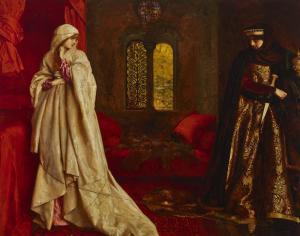
Frank Cadogan Cowper - The Blue Bird
Original 1918
Auction:
Christie's -Jun 15, 2011
- London
Lot number:
52
Other WORKS AT AUCTION
Description:
Frank Cadogan Cowper, R.A. (1877-1958) The Blue Bird signed and dated 'F. C. Cowper 1918' (lower right) and inscribed'F. Cadogan Cowper A.R.A./Edwardes Square Studios' (on the reverseof the frame) oil on canvas 34 7/8 x 28 in. (88.4 x 71.1 cm.)
The Royal Academy Illustrated 1918, London, 1918, pl. 93. Times, 4 May 1918, p. 9.
London, Royal Academy, 1918, no. 46.
Frank Cadogan Cowper was born at Wicken in Northamptonshire,where his maternal grandfather was rector. He studied art at the StJohn's Wood Art School and then spent five years in the RoyalAcademy Schools (1897 -1902) before entering the Cotswold studio ofEdwin Austin Abbey. After six months working with this Americanmuralist, who, like his friend John Singer Sargent, had taken upresidence in England, Cowper completed his artistic education bystudying for a while in Italy.
Although he exhibited widely, supporting the Royal WatercolourSociety and the Royal Institute of Painters in Oil Colours, as wellas sending to the Paris Salon, Cowper remained loyal to the RA,where he exhibited regularly from 1899 until his death nearly sixtyyears later. He became an Associate in 1907 and a full academicianin 1934. Throughout his life he painted subject pictures, althoughas the taste for these declined in the early years of thetwentieth-century he turned increasingly to portraits, specialisingin glamorous and slightly fey likenesses of young women.
Cowper's early work is strongly influenced by the Pre-Raphaelites,but by about 1906 he was adopting a more Renaissance idiom, oftenwith an emphasis on rich brocades to create a decorative effect.His RA diploma picture, Vanity, exhibited in 1907, is particularlysignificant since it borrows motifs from Giulio Romano's portraitof Isabella d'Este at Hampton Court, a picture which had inspiredthe young Burne-Jones half a century earlier. In 1908-10 hecontributed to the murals illustrating Tudor history which a groupof artists, supervised by his former master, Abbey, painted for theCommons' East Corridor in the Houses of Parliament.
Cowper spent the early part of his life in London, occupyingstudios in St John's Wood, Kensington and Chelsea. The Blue Birdwas painted at 2 Edwardes Square Studios, a southerly outpost ofthe artists' colony in Holland Park that had sprung up in the laternineteenth-century under the leadership of the President of theRoyal Academy, Sir Frederic Leighton.
At the end of the Second World War, Cowper moved toGloucestershire, settling at Fairford, not far from where he hadserved his apprenticeship with Abbey. He is often seen as the lastexponent of the Pre-Raphaelite tradition. As such, he waspatronised by Evelyn Waugh, a pioneer of the Victorian revival, andincluded in The Last Romantics, the 1989 exhibition at the BarbicanArt Gallery that celebrated the survival of Pre-Raphaelite valuesinto the age of Modernism. In fact he was responsible for one ofthe most astonishing examples, The Three Queens find Lancelotsleeping, exhibited at the RA as late as 1954.
The Blue Bird appeared at the RA in 1918, the last year of theGreat War. Military images dominated the exhibition and the picturemust have struck an incongruous note amid the portraits ofgenerals, tributes to indomitable Tommies, romanticised accounts of'bringing up the guns', and poignant war memorials. There seems tobe no iconographical connection with Maurice Maeterlinck's play TheBlue Bird, although Cowper must have been aware of the phenomenallysuccessful staging of this 'transcendental pantomime' at theHaymarket Theatre, London, in 1909-11. The costumes and sets wereby Frederick Cayley Robinson, who also illustrated the text when itwas published by Methuen in 1911.
The picture does, however, undoubtedly relate to Madame d'Aulnoy'sfairy tale of the same name, first published in 1697. This tells ofa beautiful young princess, Fiordelisa, who falls in love with ahandsome prince. He returns her love, but her wicked step-mother,wanting him to marry her own ill-favoured daughter, Turritella,shuts her up in a tower and attempts to blacken her name with hersuitor. When the prince, refusing to marry Turritella, istransformed into a Blue Bird by her fairy godmother, he flies tothe tower and holds amorous tête-à-têtes with Fiordelisa, bringingher presents of jewels as tokens of his affection.
Cowper shows the lovers enjoying one of these trysts, the princessholding a rope of pearls that the Blue Bird has evidently justgiven her. The story was retold by Andrew Lang in his Green FairyBook (1892), one of the eleven 'coloured' Fairy Books that heproduced for Longmans between 1889 and 1910. All were illustratedby H.J. Ford, and one of his designs for 'The Blue Bird' shows thesame subject as that represented by Cowper's picture.
Formally, the picture is a good example of Cowper'sneo-Renaissance-cum-neo-Pre-Raphaelite style, repeating the formulahe had established with Vanity eleven years earlier and payinghomage to Rossetti's half-length likenesses of beautiful modelswith exotic accessories, an idiom itself owing much tosixteenth-century Venetian painting. Like Rossetti, he gives hiscomposition a decorative, almost heraldic, character and reducesthe picture space to a narrow foreground plane. Both objectives areachieved by introducing a backdrop of the rich brocade that isalmost a signature with Cowper.
This motif is derived from the so-called 'cloth of honour' that sooften hangs behind the Virgin and Child in Italian Renaissancepaintings (other works by Cowper establish the link beyond doubt).Meanwhile portraits of the Renaissance period, particularly thoseof the early German masters, inspire such details as the model'sslashed red sleeves, her close fitting coif, and the chemisegathered across her neck. As for the Blue Bird's crown-shapedcollar, intended to symbolise his royal status, this recallsmedieval livery badges in which such collars are often worn byanimals. If Cowper had an example in mind, however, it cannot havebeen the famous Dunstable Swan Jewel in the British Museum, whichwas not discovered until 1965. A more likely possibility is theWilton Diptych, where badges in the form of white harts wearingcrown collars are worn by all the angels and the figure of KingRichard II. But even this did not enter the National Gallery until1929.
Frank Cadogan Cowper - Portrait Of Elizabeth Witts
Original 1954
Auction:
Bonhams -Jun 17, 2009
- Oxford
Lot number:
262
Other WORKS AT AUCTION
Description:
Frank Cadogan Cowper (British, 1877-1958)
Portrait of Elizabeth Witts, wearing a white satin gown, and seated before a tapestry
signed and inscribed: 'Elizabeth/Daughter of Major-General F.V.B. Witts, C.B.E., C.S.O., M.C./painted 1954 by/F.Cadogan Cowper R.A.' (on label verso),
oil on canvas, unframed,
128
x 101cm
(50 3/8
x 39 3/4in).
Footnote: See illustration
Frank Cadogan Cowper - The Golden Bowl
Original 1955
Auction:
Sotheby's -Jun 7, 2005
- London
Lot number:
60
Other WORKS AT AUCTION
Description:
description
measurements
measurements note
110 1/2 by 74 cm. ; 43 1/2 by 29 in.
description
signed and inscribed on an old label pasted to the central stretcher:
the golden bowl/ painted 1955 by/ f. cadogan cowper, r.a.
oil on canvas
exhibited
royal academy, 1956, no. 401