Coeur D'alene | ||||||||||||||||||||
| ||||||||||||||||||||
Some artworks auctioned at Coeur D'alene selected by the database of Arcadja Auctions.
| Browse the list of auctions held by Coeur D'alene which Arcadja has followed for you.
|
Some works sold by Coeur D'aleneCarl Clemens Moritz Rungius - Goats
Original
Auction:
Coeur d'Alene -Jul 24, 2010
- Hayden
Lot number:
1
Other WORKS AT AUCTION
Description:
Carl Rungius (1869-1959) Etching on Paper
Carl Rungius (1869-1959),
Goats,
etching on paper,
8 x 11 inches,
signed lower right.
Verso : “Inscribed for Morton Quantrell by C. R. Jan. 18th1951.” (in the artist’’’’’’’’s hand),
“Gift to MortonQuantrell from Dad Jan. 18,
1951 at Buckskin dinner ofCamp Fire Club. Rungius was our guest.”
Literature: Donald E. Crouch,
Carl Rungius: TheComplete Prints (Missoula,
Montana: Mountain PressPublishing,
1989),
page 115,
plate13,
illustrated.
Provenance: The Artist. Morton Quantrell,
Camden,
Maine,
1951
Ernest Martin Hennings - Riders In The Sage
Original -
Auction:
Coeur d'Alene -Jul 24, 2010
- Hayden
Lot number:
67
Other WORKS AT AUCTION
Description:
E. Martin Hennings (1886-1956) Oil on Canvas
E. Martin Hennings (1886-1956),
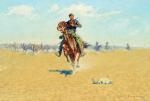
Riders in the Sage,
oil on canvas,
20 x 24inches,
signed lower left.
According to Patricia Broder,
“Henning’’’’’’’’s mostsuccessful canvases are those in which he interwove the threads oflandscape and figure forms. His special talent lay in this abilityto integrate human figures and natural forms into a singleaesthetic creation. Silhouettes of standing and seatedfigures,
tree trunks,
branches,
foliage,
sage,
and underbrush,
adobebuildings,
woodland paths,
and the river’’’’’’’’sedge ? all are interdependent forms. …These decorative compositionsgreatly resemble brightly woven tapestries. Portrait and landscapeare fused into a harmonious whole that proclaims the beauty and thevitality of life in Taos.”
Riders in the Sage was part of the personal collection of Dr.T. W. Williams,
a physician from West Texas,
andlong-time director of the West-Texas Chamber of Commerce. Dr.Williams had a particular interest in art portraying NativeAmericans as he himself was of American Indian descent on hismaternal side. Born in 1900 in Kemp,
Texas,
Dr.Williams attended Southwestern University at Georgetown and BaylorMedical School. He began practicing medicine in Haskell,
Texas in the 1930s. During this time he began traveling to NewMexico in the summer and continued to visit each summer throughouthis lifetime. He and his young family travelled about and spentseveral summers vacationing in a cabin outside of Taos,
during which time he befriended the group of artists livingthere and began a collection of their artwork. He continued to be apatron of the artists of New Mexico over the course of hislifetime.
Provenance: The Artist. Dr. T.W. Williams Sr.,
HaskellTexas,
1930s. Present owners,
bydescent.
In every picture I expect the fundamentals to be observed,
which I term ? Draftsmanship,
design,
form,
thythm,
color. Art must of necessity bethe artist’’’’’’’’s own reaction to nature ~ E. MartinHennings
Nicolai Ivanovich Fechin - Twilight
Original -
Auction:
Coeur d'Alene -Jul 24, 2010
- Hayden
Lot number:
107
Other WORKS AT AUCTION
Description:
Nicolai Fechin (1881-1955) Oil on Canvas Mounted onAluminum
Nicolai Fechin (1881-1955),
Twilight,
oil on canvas mounted on aluminum,
30 x 24 inches,
signed lower right.
Finding himself in some financial difficulty during the hardtimes of the 1930s,
Nicolai Fechin was taken in by AlbertWells who provided him with a place to stay as well as a studio towork in. Living with the Wells’’’’’’’’ until he got back on hisfeet,
Fechin gave family members numerous paintings anddrawings to express his gratitude. Twilight has been in the Wellsfamily since Fechin painted it.
Gerard Curtis Delano - In Bonnet And Paint
Original -
Auction:
Coeur d'Alene -Jul 24, 2010
- Hayden
Lot number:
134
Other WORKS AT AUCTION
Description:
Gerard Curtis Delano (1890-1972) Oil on Canvas
Gerard Curtis Delano(1890-1972),
In Bonnet and Paint,
oil oncanvas,
30 x 40 inches,
signed lowerright.
According to Delano biographer,
Richard G.Bowman,
“In studying Delano’’’’’’’’s Western historicalworks,
including his depictions of historic PlainsIndians,
we find the artist becoming moreillusionary,
attimes,
leaning toward the mythical. Although his PlainsIndians were often shown mounted and with are regalia andpaint,
he created tranquil rather than threatening images.It is not too surprising then that these same heroic subject appealas much to female viewers as to men. (Not so with the work of manyartists who have painted the same subject matter.) Delano was not ahistorian. Research on historical material culture was not an endin itself for him. The design of the paining,
thecolor,
simplicity,
and pictorial impact,
all had precedence over historical or technical details. He wasnever preoccupied with these minutia.”
Literature: Richard G. Bowman,
Walking With Beauty -The Art and Life of Gerard Curtis Delano (Denver,
Colorado: Richard G. Bowman,
1990),
pages74-5,
illustrated.
Joseph Henry Sharp - Acoma Pottery Decorators
Original 1928
Auction:
Coeur d'Alene -Jul 24, 2010
- Hayden
Lot number:
199
Other WORKS AT AUCTION
Description:
Joseph Henry Sharp (1859-1953),
Acoma Pottery Decorators (1928),
oil on canvas,
25 x 30 inches,
signed lower right.
According to Forrest Fenn in Teepee Smoke,
“Indiansand their culture were a dominant concern in Sharp’’’’’’’’s life. Thestories of their battles bravely fought and their heroic deedsamidst great hardships absolutely consumed Sharp as a young boygrowing up in Ohio. These stories controlled his thoughts,
his movements,
and his art for the eight years hespent avidly painting Indian subjects. Indeed,
Sharp wasunrivaled in his effort to document the proud heritage andcivilization of the people whose culture he knew was destinedultimately to vanish in the face of the overwhelming westernmovement of the white man and his machines.”
| |