Constantin Brancusi
Tweet
Follow the artist with our email alert
Romania ( 1876 -  1957 ) -  Artworks Wikipedia® - Constantin Brancusi
Christie's / Apr 4, 2013
€38,627.94 - €54,079.11
€82,432.13
Find artworks, auction results, sale prices and pictures of Constantin Brancusi at auctions worldwide.
Go to the complete price list of works
Along with Constantin Brancusi, our clients also searched for the following authors:
Jean-Michel Basquiat, Ansel Adams, Mark Rothko, Francis Bacon, Maurizio Cattelan, Amedeo Modigliani, Alberto Giacometti, Viktor Vasarhely, Mike Mitchell, Irving Penn, Damien Hirst
Artworks in Arcadja
146
Some works of Constantin Brancusi
Extracted between 146 works in the catalog of Arcadja
Constantin Brancusi - Etude De Mlle Pogany
Original
Auction:
Christie's -
Jun 18, 2013- London
Lot number:
34
Other WORKS AT AUCTIONDescription:
Constantin Brancusi (1867-1957) Etude de Mlle Pogany signed 'C.Brancusi' (lower right) gouache on board 25 1/8 x 19½ in. (63.8 x 49.5 cm.)
Charles Sheeler, New York, a gift from the artist in 1926, and thence by descent. Terry Dintenfass Gallery, New York, by whom acquired from the above. Saidenberg Gallery, New York, by whom acquired from the above in February 1973. Fuji Gallery, Tokyo, by whom acquired from the above in 1973. Achim Moeller Fine Art, New York. Eleanore & Daniel Saidenberg, New York, by whom acquired from the above in 1975; their sale, Sotheby's, New York, 10 November 1999, lot 15. Acquired at the above sale by the present owner.
PROPERTY FROM A PRIVATE EUROPEAN COLLECTION
C. Giedion-Welcker, Constantin Brancusi, 1876-1957, Basel, 1958, p. 78 (illustrated pl. 26, p. 79; in the image in the catalogue raissone the face appears more contrasted).
Etude de Mlle Pogany is an intriguing portrait study in which Constantin Brancusi has reduced the forms and appearance of his most famous muse to a crisp, near-geometric distillation of form. There is a near-Purist rigour to this image which is accentuated by the deliberately limited palette that Brancusi has employed in capturing the ovals, circles and other shapes with which he has conjured the Hungarian painter, shown here leaning a head on her hand, the background more angular with the right-angled crow-stepping of the chair against a monochrome field.
Margit Pogany met Brancusi in Paris around 1910 and soon asked if he would create a portrait of her. Later, Pogany would move to Australia; her recollections of sitting for Brancusi provide an intriguing insight into his working techniques in sculpture, as she remembered him creating clay sketches which he would destroy at the end of each sitting. It was only after her departure that he finally created the lyrical, radically simplified portrait bust, created in bronze and marble, which would mark his determined step onto the path towards a near-abstract reduction of form. That reduction is likewise clear in Etude de Mlle Pogany, where the face has been rendered with similar arcing eyebrows delineating the orbits of the eyes. Here, though, those eyes appear almost closed in opposition to the wider ones in the portrait; in that sense, Etude de Mlle Pogany may relate more to his Danaïde, also considered to be based on her features.
Margit Pogany remained a friend and correspondent with Brancusi for a long time, a Muse able to inspire him not least through her appearance and the helmet of dark hair visible in Etude de Mlle Pogany. This picture would later become associated with another artist: it was given by Brancusi to Charles Sheeler, a pioneer of Modernism in New York who worked in the fields of painting and photography alike. Indeed, Sheeler was one of the few photographers Brancusi trusted enough to capture images of his own work, as well as taking portrait shots of Mrs Eugene Meyer which the sculptor could use as working documents.
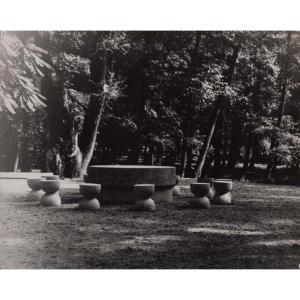
Constantin Brancusi - Sans Titre
Original 1920
Auction:
Sotheby's -
May 29, 2013- Paris
Lot number:
74
Other WORKS AT AUCTIONDescription:
LOT 74
CONSTANTIN BRANCUSI (1876 - 1957)
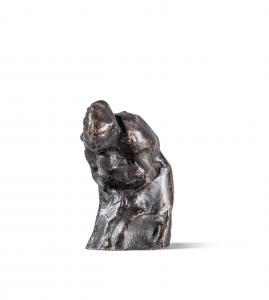
SANS TITRE, ANNÉES 1920
VINTAGE SILVER PRINT ON POST-CARD. ON THE REVERSE, ANNOTATED BY CONSTANTIN BRANCUSI IN BLACK INK.
Tirage argentique d'époque sur carte postale. Au verso, annoté par Constantin Brancusi à l'encre noire.
14 x 9 cm (5 ½ x 3 ½ in.)
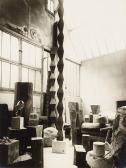
Constantin Brancusi - View Of The Studio: Portrait Of Madame L.r.
Original 1920
Other WORKS AT AUCTIONDescription:
40
CONSTANTIN BRANCUSI
View of the Studio: Portrait of Madame L.R.,
circa 1920
Gelatin silver print.
26.4 x 19.7 cm (10 3/8 x 7 6/8 in)
Estimate
£30,000 - 50,000 ‡ ♠
MORE LOT DETAILS
Provenance
From the artist to Walter Pach
Private Collection, Switzerland
Literature
The Little Review
, vol. 8, Brancusi Number, New York, (Autumn 1921), pl. 7
Brancusi Photographe
, Paris: Centre Georges Pompidou, 1977, p. 16
H. Kramer,
Brancusi, The Sculptor as Photographer
, London: David Grob Editions, 1980, pl. V1 (detail)
F. T. Bach, M. Rowell, A. Temkin,
Constantin Brancusi
, Paris: Centre Georges Pompidou/Philadelphia Museum of Art, 1995, p. 170
La Collection L’’Atelier Brancusi
, Paris: Centre Georges Pompidou, 1997, p. 58
C. Giménez, M. Gale, eds.,
Constantin Brancusi, The Essence of Things
, exh. cat., Tate Gallery, London, 2004, p. 18
Constantin Brancusi and Richard Serra,
A handbook of possibilities
, Basel: Foundation Beyler, 2011, p. 67
CONTACT SPECIALIST
Lou Proud
Head of Photographs, London
lproud@phillips.com
+ 44 207 318 4092
CONDITION REPORT
SHARE
Constantin Brancusi - 'le Nouveau Né Ii'
Original 1923
Auction:
Christie's -
Apr 4, 2013- New York
Lot number:
3
Other WORKS AT AUCTIONDescription:
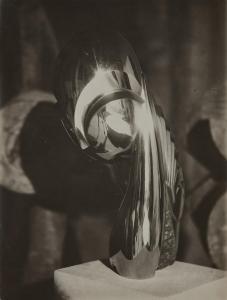
CONSTANTIN BRANCUSI (1867-1957) Two Sculptures: 'Le Nouveau Né II', 1920 and 'L'Enfant Dormant', 1906, 1923 gelatin silver print, printed 1930s credit blindstamp (on the recto); annotation 'H.P. Roché' in an unknown hand in ink (on the verso) image/sheet: 11¾ x 15¾in. (29.8 x 40cm.)
This study by Brancusi is one of a group discovered in Paris in the late 1970s. One of the finest and most complex examples from the artist's large body of photographs, the print is in an unusually large format and shows two Brancusi sculptures, Enfant Dormant, 1906, in colored plaster (now in the Atelier Brancusi of the Musée national d'art moderne, Paris) and Le Nouveau Né, 1920, in white marble (now in the collection of the Moderna Museet, Stockholm).
Although Brancusi had always photographed his sculpture from the beginning of his career, it was only in the 1920s that he became excited about making prints with a more profound vision. He asked Man Ray to help him choose a new camera and a steady tripod, although he rejected advice to send his negatives out to be developed by a commercial laboratory and instead built a darkroom in the corner of his studio.
Modernist Masterworks to 1925 from 'the deLIGHTed eye', A Private Collection, International Center of Photography, New York, 1985, p. 14
Modernist Masterworks to 1925 from 'the deLIGHTed eye', A Private Collection, International Center of Photography, New York, May 15-June 16, 1985
Henri-Pierre Roché, whose name is inscribed on the reverse of this print, is rarely referenced today, but he was nonetheless a highly significant figure in the story of the Paris avant-garde of the early 20th century. Roché (1879-1959) was an author, best known for the novel Jules et Jim. Urbane, intellectually sophisticated, and with a sure eye for true invention and integrity in art, he played an important role in the Paris art scene during the birth of modernism. As a refined connoisseur, adviser, and agent, he provided counsel and support to key players in this milieu -- he worked with the great collector Jacques Doucet, introduced Gertrude Stein to Picasso, financed Man Ray's first studio, befriended and supported Brancusi, and acted as cultural guide to the young Indian Prince destined, as Maharaja of Indore, to earn a reputation as a notable patron of modern art and architecture. It was Roché, typically, who stimulated the Prince's passion for the sculptures of Brancusi.
Constantin Brancusi - L’’’’oiseau Dans L’’’’espace Avec L'ombre De La Fenêtre (bird In Space)
Original 1932
Other WORKS AT AUCTIONDescription:
Close
CONSTANTIN BRANCUSI
While seven variant images of Constantin Brancusi’’s famed
Bird in Space
reside in the collection of the Centre Georges Pompidou, Paris, the print being offered in the current lot is likely to be a unique example of this image.
Constantin Brancusi’’s photographs of his sculptures reveal his ongoing evolution in both practices. After studying at the School of Arts and Crafts in Craiova (1894–1898)and the National School of Fine Arts in Bucharest (1898–1902), Brancusi moved to Paris in 1904. The next year he enrolled at the famed École des Beaux-Arts and soon began an apprenticeship under the sculptor August Rodin. The latter introduced Brancusi to the then-budding American photographer Edward Steichen, possibly the first practitioner of the medium who would come to influence Brancusi’’s photographs. In 1905, Brancusi began photographing his own sculptures, always within the intimate and
familiar confines of his studio.
In 1907 Brancusi began carving—as opposed to molding—his sculptures, which, over the next few decades, would become increasingly streamlined, simplified and abstract. Perhaps no other body of work reflects the evolution of his approach as much as
Bird in Space
, of which the current lot is an example. Interestingly, this body of work began in the 1920s, shortly after Brancusi crossed paths with another American photographer, Man Ray. From that point forward, Brancusi’’s photographic exploration of his work became far more extensive and meticulous. It was his strong belief that only he, as the sculptor, could capture the essence of his works in his photographs. In fact, upon seeing Alfred Stieglitz’’ s photograph of his studio, Brancusi lamented, “the photograph is beautiful, but it does not represent my work.” Indeed, from his perspective, the photographs of his sculptures were to serve a purpose that was beyond documentarian. For Brancusi, they were to serve a dual function—enhancing his understanding of his sculptures as well as turning the photographs into “printed memories,” as he termed them, depictions of the sculptures’’ essence by which he wanted them remembered.
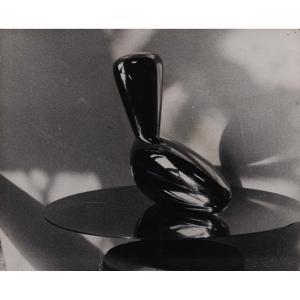
The current lot depicts Brancusi’’s
Bird in Space
, circa 1932, one of seven marble variants of the same title. Photographs of variants created as early as 1923 often depict the sculptures surrounded by raw chunks of stone or other sculptures by Brancusi. In that regard, the sleek and impossibly elegant beauty of the
Bird in Space
sculptures was understood in relation to other, more rugged, voluminous forms.
By 1930, however, Brancusi eliminated almost all surrounding objects and allowed the
Bird in Space
sculptures to autonomously occupy the frame. Further accentuating their domineering presence, Brancusi often lit the sculptures from above, rendering them as dramatic verticals searing across the frame. In the current lot Brancusi further abstracted his depiction of the sculpture. A rhomboid-shaped source of light illuminates the sculpture, casting a penumbral echo on the wall behind it and thereby doubling the sculpture’’s presence within the frame. A clean-edged shadow is cut into the wall, thereby presenting a photographic “carving”, in keeping with Brancusi’’s preferred method of sculpting. Moreover, the clearly delineated silhouette potentially pays a nuanced homage to the rayographs pioneered by Brancusi’’s photographic mentor, Man Ray. Indeed,
Bird in Space
, circa 1932, is a majestic and compelling depiction of Brancusi’’s continued exploration of his own work through his newfound passion for photography.
178
CONSTANTIN BRANCUSI
L’’’’oiseau dans l’’’’espace avec l'ombre de la fenêtre (Bird in Space)
, circa 1932
Gelatin silver print.
9 1/2 x 7 in. (24.1 x 17.8 cm)
ESTIMATE $50,000 - 70,000
PROVENANCE
Vera Moore, the artist’’s wife
John Moore, the artist’’s son
Galerie Flak, Paris
Private Collection, Paris
LITERATURE
Centre Georges Pompidou,
Les carnets de l'Atelier Brancusi
, no. 126 for a variant
Coplans,
Brancusi: Photographer
, pls. 88-91 for a series of variants
Contact Specialist
Request Condtion Report
Recieve Email alerts
While seven variant images of Constantin Brancusi’’s famed
Bird in Space
reside in the collection of the Centre Georges Pompidou, Paris, the print being offered in the current lot is likely to be a unique example of this image.
Constantin B...
Read More...
View catalogue
Purchase catalogue
Annual subscriptions