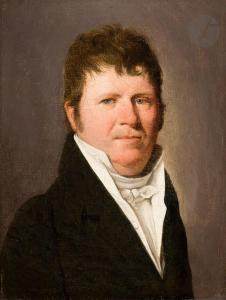
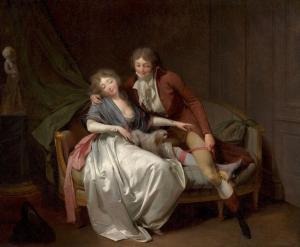
Louis Leopold Boilly
TweetFollow the artist with our email alert
France (La Bassèe 1761 - Paris 1845 ) - Artworks Wikipedia® - Louis Leopold Boilly

Christie's /Jul 6, 2011
€45,402.96 - €68,104.44
Not Sold
Find artworks, auction results, sale prices and pictures of Louis Leopold Boilly at auctions worldwide.
Go to the complete price list of works
Variants on Artist's name :

Boilly Louis Léopold

Along with Louis Leopold Boilly, our clients also searched for the following authors:
Henri Matisse, Francis Bacon, Andy Warhol, Jean-Michel Basquiat, Pablo Picasso, Giorgio De Chirico, Mike Mitchell, Lucio Fontana, Mark Rothko, Damien Hirst, Jeff Koons
Artworks in Arcadja
386Some works of Louis Leopold Boilly
Extracted between 386 works in the catalog of ArcadjaLouis Leopold Boilly - Les Chiens Chéris
Original
Lot number:
181
Other WORKS AT AUCTION
Description:
Louis Léopold Boilly (French 1761-1845)
Les Chiens Chéris
Oil on panel
20 x 17cm; 8 x 6¾in
Provenance:
Hazlitt Gooden and Fox Ltd, London
Panel slightly bowed, some small areas of old retouching visible under uv light
Estimate:
£15,000-20,000
Lot:
181
Sale: Paintings (PW210312)
Louis Leopold Boilly - Portrait Of A White-haired Man
Original
Auction:
Sotheby's -Jan 26, 2012
- New York
Lot number:
80
Other WORKS AT AUCTION
Description:
LOT 80
LOUIS-LÉOPOLD BOILLY
LA BASSÉE 1761 - 1845 PARIS
PORTRAIT OF A WHITE-HAIRED MAN, HALF LENGTH, WEARING GLASSES
inscribed and dated in Latin in an old hand on the reverse of the original stretcher: Caducini... dipinctus pridie/ kalend. maii. 1807. .... Boilly... pictor/ ....
oil on canvas
8 5/8 by 6 3/4 in.; 21.9 by 17 cm.
Louis Leopold Boilly - Les Femmes Se Battent; And Les Hommes Se Disputent The First
Original 1818
Auction:
Christie's -Jan 25, 2012
- New York
Lot number:
138
Other WORKS AT AUCTION
Description:
Louis-Léopold Boilly (La Bassée 1761-1845 Paris) Les Femmes se battent; and Les Hommes se disputent the first signed and dated 'L.Boilly 1818' (lower right) oil on canvas, unlined the first 13 x 16 in. (33 x 40.6 cm.); the second 12¾ x 16 in. (32.4 x 40.6 cm.) a pair (2)
Lehideux-Vernimmen, before 1930. with Didier Aaron, Paris, in 1980. Anonymous sale; Lille, Maître Mercier, 20 December 1993, lot 105. Private collection, Paris. Anonymous sale; Christie's, New York, 24 January 2003, lot 123.
H. Harrisse, Louis-Léopold Boilly, Peintre-Dessinateur-Lithographe, Paris, 1898, p. 110, nos. 307-308. P. Marmottan, Le Peintre Boilly, Paris, 1913, p. 151. A. Mabille de Poncheville, Louis Boilly, Paris, 1931, p. 141. J. Adhémar, Inventaire du fonds français après 1800, Paris, 1949, IV, p. 291. J.S. Hallam, The genre works of Louis-Léopold Boilly, unpublished Ph.D dissertation, University of Washington, 1979.
Paris, Galerie Charpentier, Hôtel Sagan, Louis-Léopold Boilly, May-June 1930, nos. 34-35. New York, Didier-Aaron, Exposition, 1980, no. 40.
Born at La Bassée, near Lille, in 1761, Boilly received his only documented training from the well-known trompe-l'oeil painter Dominique Doncre (1743-1820). He worked for a short period in Douai and Arras before moving to Paris in 1785, where he exhibited at the Salon regularly from 1791 until 1824. Boilly was a fashionable painter whose career spanned over 70 years, and included numerous exercises in portraiture, history subjects, scènes galantes and scenes of everyday life in contemporary Paris.
In the present pair of paintings, we see Boilly depicting contemporary genre scenes with the flavor of 17th-century Dutch paintings by artists such as Teniers and Brouwer. We find ourselves in popular, working-class cafés where there are no social antagonisms, rather a difference of opinion among people of the same social strata. In one painting, Les femmes se Battent ('Women Fighting'), we see a brutal altercation between two women who need to be torn away from each other by shocked onlookers; in the other, Les Hommes se Disputent ('Men Arguing'), a man raises his fist in anger, swearing an oath at a companion drinking across the table. Painted in 1818, these works recreate the tumultuous agitation and electrifying ambiance often found in houses of public drink. The mise en scène in these episodes of struggle bring to mind the surging crowds in other paintings by Boilly, notably L'Entré du thèâtre de l'Ambigu un jour de spectacle gratis (Louvre, Paris); and the attitude of the man raising his fist is similar to that of the old man in the early genre scene L'Amant Jaloux (Musée de Saint-Omer).
In the Salon of 1819, Boilly exhibited a painting depicting the interior of a wine merchant's boutique, an Jal, in his critique of that year's exhibition, described without naming it a composition that seems very similar to Les Femmes se Battent -- could he have been writing about the present picture? Unfortunately, the Salon livret for 1819 gives no indication that Boilly exhibited this pair of pictures.
There are several watercolors by Boilly associated with Les Femmes se Battent, one of which -- signed and dated 1820 -- appeared in the sale of the comte Jacques de Bryas on 4 April 1898. A second is mentioned by Henri Harrisse under the title Dispute de femmes, and a third, which is signed and dated 1823, was formerly in the collection of David and Constance Yates, New York. In 1821, acquatints of the two paintings were published in reverse by Champonnier. Other lithographs by Delpech -- entitle Le Coup de Peigne and Le Defi -- develop the themes of conflict found in the present paintings.
The present painting will be included in the catalogue raisonné of paintings by Boilly now in preparation by Étienne Breton and Pascal Zuber.
Louis Leopold Boilly - The Cherished Turtle Dove
Original
Auction:
Christie's -Jul 6, 2011
- London
Lot number:
184
Other WORKS AT AUCTION
Description:
Louis-Léopold Boilly (La Bassée 1761-1845 Paris) The cherished Turtle Dove; and The unfounded fear oil on canvas 10 x 12¾ in. (25.5 x 32.3 cm.) a pair (2)
Marie Dauw-de Bruyn, Relst Castle, Kampenhout, Belgium, before1940. Geneviève Van den Eynde, Louvain. Eliane Claikens, Brussels, and by inheritance.
We are grateful to Pascal Zuber for confirming the attribution,on the basis of photographs, and for providing information relatingto the engravings (above) and drawings that relate to thesecompositions (in a private collection, Switzerland; anduntraced).
Louis Leopold Boilly - A Trompe-l'oeil Of An Ivory And Wood Crucifix Hanging On A Wall
Original
Auction:
Christie's -Jul 5, 2011
- London
Lot number:
20
Other WORKS AT AUCTION
Description:
Lot Description
Louis-Léopold Boilly (La Bassée 1761-1845 Paris)
A trompe-l'oeil of an ivory and wood crucifix hanging on a wall
signed, dated and inscribed 'L.Boilly. pinx: rue Meslée. n
o
12, A Paris.' (lower left, on the cartellino)
oil on canvas
25 x 18 in. (63.5 x 45.7 cm.)
Provenance
George Rushout, 3rd Baron Northwick (1811-1887), Northwick Park, Gloucestershire, and by descent through his widow to
Captain E.G. Spencer-Churchill (1876-1964); (+), Christie's, London, 29 October 1965, lot 65, where bought by Leggatt for the Dulverton Trust.
Saleroom Notice
Please note that the estimate for this lot should read £250,000-350,000.
Pre-Lot Text
THE PROPERTY OF THE DULVERTON TRUST
Literature
R.J. Durdent, Galerie des Peintres français du Salon de 1812, Paris, 1813, p. 54.
A Catalogue of the Pictures, Works of Art, etc., at Northwick Park, 1864, no. 402.
E. Bellier and L. Auvray, Dictionnaire général des artistes depuis l'origine des arts du dessin jusqu'à nos jours, Paris, 1882, I, p. 109.
H. Harrisse, L.L. Boilly, peintre, dessinateur et lithographe. Sa vie et son oeuvre, 1761-1845, Paris, 1898, pp. 26, 55, 82 and 137, no. 39.
P. Marmottan, Le Peintre Louis Boilly (1761-1845), Paris, 1913, pp. 134-5.
T. Borenius, A catalogue of the Collection of Pictures at Northwick Park, 1921, no. 84.
J.S. Hallam, The genre works of Louis-Léopold Boilly, Washington, 1979, pp. 104-105, 250, fig. 113.
S. Siegfried, 'Boilly and the Frame-up of Trompe-l'oeil', Oxford Art Journal, Oxford, 1992, XV, no. 2, p. 33, fig 10.
S. Siegfried, The Art of Louis-Léopold Boilly, New Haven and London, 1995, pp. 187-8, pl. 162.
M.-C. Chaudonneret, The Grove Dictionary of Art, ed. by J. Turner, London, 1996, IV, p. 241.
J.P. Marandel, Eye for the Sensual. Selections from the Resnick Collection, exhibition catalogue, 2011, p. 55.
Exhibited
Paris, Salon, 1812, no. 110.
Paris, Salon, 1814, no. 115.
Paris, Grand Palais, De David à Delacroix, 1974-1975, p. 324, no. 9, pl. 142.
Dijon, musée des beaux-arts, La Peinture française de 1774 à 1830, 1982-1983, no. 474.
Fort Worth and Washington DC, The Art of Louis-Léopold Boilly, Modern Life in Napoleonic France, 1995, no. 44.
Washington National Gallery of Art, Five Centuries of Trompe-l'oeil Painting, Deceptions and Illusions, 2002-2003, no. 52.
Magdalen College, Oxford, Chapel, on loan 1966-2011.
View Lot Notes ›
Described by the critic Durdent at the 1812 Paris Salon as 'a small trompe l'oeil imitating ivory, and of a fine taste in drawing', this tour de force of the genre is the only known picture of this subject by Boilly, and surely one of the most strikingly direct paintings in his oeuvre.
Painted in harmonious tones of white, grey and brown, it depicts an ivory Crucifix attached to a wooden cross hanging on a grey/beige wall. The ivory figure of Christ is likely to have been copied by Boilly after a model traditionally attributed to François Girardon (1628-1715) and is similar to one that belonged to Bossuet now in the Musée de l'histoire, Hôtel de Soubise, Paris, and even closer to one copied in bronze in the early 19th century, at La Sculpture Françoise, Paris.
To the left of the Crucifix, Boilly painted a cartellino with his signature and address, positioned as if it were tucked under the edge of the picture's frame, inviting the Salon visitor or viewer to remove it. As noted by Vilain (loc cit.), the painted device of a piece of paper bearing his details, was employed by Boilly on a number of occasions and connects the artist with a long history of illusionistic painting going back at least to the art of the late 15th century Venetian, Giovanni Bellini. At the same time Boilly - here perhaps rather riskily, given the subject matter - displayed his commercial acumen, noting and skilfully drawing attention for any potential client to his full address in the Rue Meslée, to where he had moved by 1808. The Trompe-l'oeil was indeed a perfect way for artists to demonstrate and show off their technical skill, which in his case Boilly is thought to have developed in Arras under the still life and trompe-l'oeil specialist, Dominique Doncre (1743-1820), before moving to Paris in 1785. Furthermore, by depicting a sculpture so convincingly in oils, Boilly was consciously evoking the centuries old paragone or dialogue between the respective representational merits of painting and sculpture. Given that in this picture he proves how the former can so successfully represent the latter, it is clear on which side of the argument he fell.
In 1912, the late Captain E.G. Spencer-Churchill inherited Northwick Park, Gloucestershire, and its contents from his maternal grandmother, the widow of the 3rd and last Lord Northwick. There were about 400 Old Masters including a number which the 3rd Lord Northwick had 'bought back' during the series of sales by Phillips which followed the death intestate of his uncle the 2nd Lord Northwick in 1859. The Crucifix was not part of the 1859 sales, but was recorded in the 1864 catalogue of pictures at Northwick Park. It is most likely that it had been acquired by the 2nd Lord Northwick (1770-1859) who, during his lifetime, had put together a very distinguished collection of paintings by Old Masters and contemporary artists, prints, coins, miniatures, enamels and other objects which were mostly housed at Northwick Park, his home near Moreton-in-Marsh, Gloucestershire where he built a gallery in 1832. When this became too small he purchased Thirlestane House in Cheltenham to which he allowed access to connoisseurs who wished to see the collection. He also had a gallery at Connaught Place in London.
This picture will be included in the forthcoming catalogue raisonné on Boilly by Etienne Breton and Pascal Zuber, for whose assistance we are very grateful.